
Introduction
The medical device landscape in Latin America is rapidly evolving, influenced by a multitude of factors ranging from regulatory complexities to the integration of cutting-edge technologies. In Colombia, the classification of medical devices into distinct risk categories lays the groundwork for a robust regulatory framework, ensuring patient safety and product efficacy.
As researchers and industry professionals embark on the journey of clinical trials, understanding the intricate stages—from pilot to post-market studies—becomes paramount. However, this path is fraught with challenges, including:
- Patient recruitment
- Regulatory compliance
- Data management
All of which demand innovative strategies and meticulous planning.
With emerging trends and therapeutic areas gaining traction, the collaboration between stakeholders is more critical than ever, paving the way for advancements that promise to enhance healthcare outcomes.
This article delves into the essential aspects of medical device trials in Colombia, offering insights into the regulatory landscape, trial management, and the future of Medtech innovations in the region.
Fundamentals of Medical Devices: Definitions and Classifications
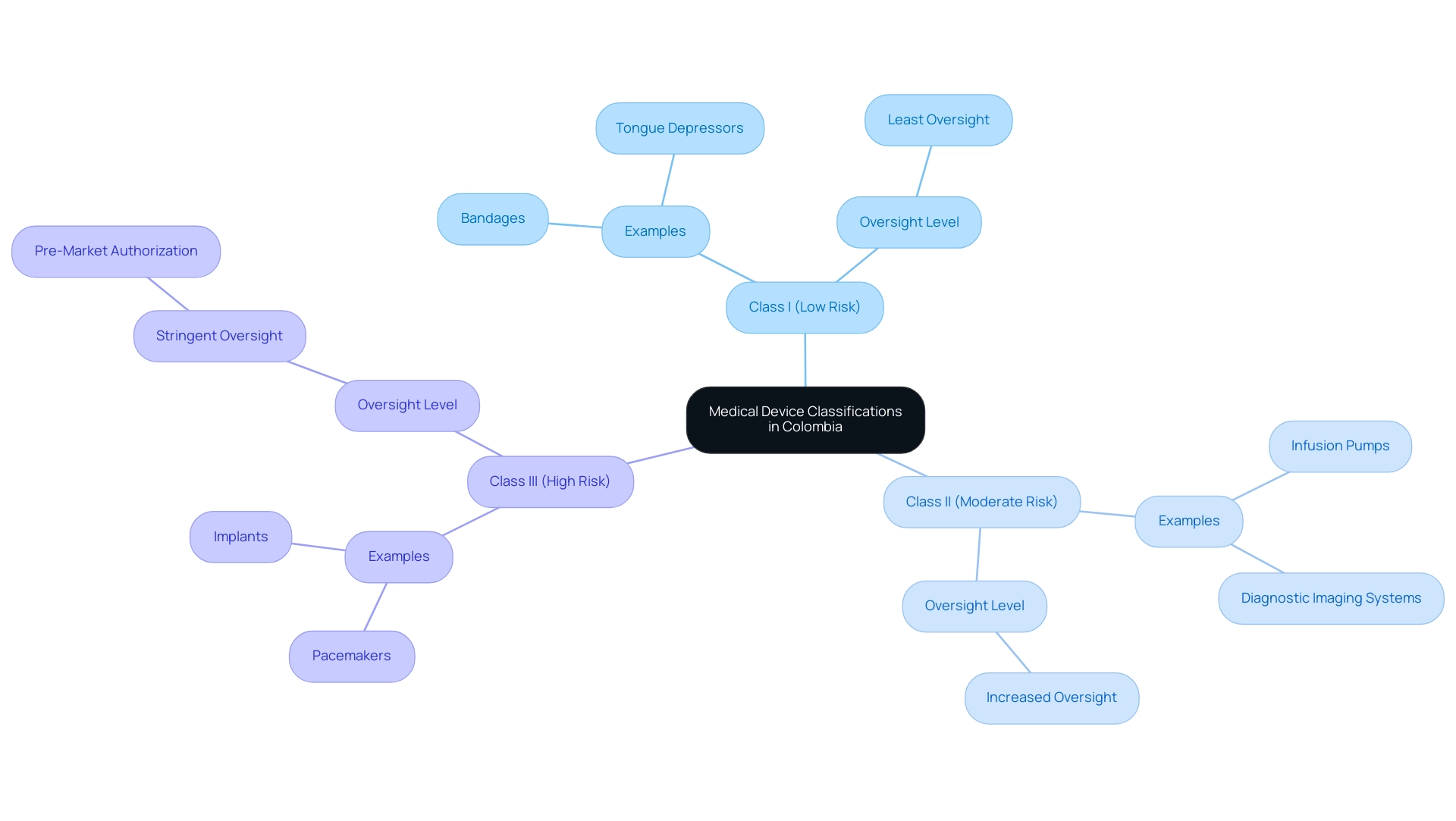
In Colombia, medical instruments are classified into three categories according to their risk level, as established by authorities such as (Colombia National Food and Drug Surveillance Institute).
- , such as bandages and tongue depressors, pose the lowest risk and are subject to the least oversight.
- , including infusion pumps and diagnostic imaging systems, need increased oversight because of their moderate risk.
- , like pacemakers and implants, are considered the highest risk and require stringent oversight, including pre-market authorization due to their potential effect on patient health.
Comprehending these classifications is essential for researchers maneuvering through the intricacies of and equipment evaluations efficiently, especially in the framework of ‘s supervision, which guarantees the safety, efficacy, and quality of in line with PAHO/WHO standards. ‘s Directorate for Medical Devices and other Technologies plays a vital role in monitoring compliance, suggesting technical standards, and overseeing both pre- and post-market evaluations.
Katherine Ruiz, a Regulatory Affairs expert with extensive experience at , emphasizes the importance of adhering to these classifications and her contributions in facilitating the import licenses for diagnostic reagents and , underlining her depth of expertise in the regulatory process.
Navigating the Stages of Medical Device Clinical Trials
Medical device clinical studies typically advance through several key stages, each of which is supported by from bioaccess®:
-
include pilot studies that assess feasibility, safety, and design before larger research. and selection of research sites and principal investigators, helping to refine research hypotheses and protocols. Their ensures that each test is tailored to meet specific needs.
: These larger studies provide for , concentrating on the safety and effectiveness of the tool in a specific patient population. With over 20 years of experience in Medtech, bioaccess® ensures compliance through thorough reviews of study documents and experiment setup, enhancing the reliability of the data collected. are conducted after a product is approved to monitor in a real-world setting. bioaccess® manages project oversight and provides detailed reporting on study status, inventory, and adverse events. Comprehending these stages, along with the knowledge and tailored services offered by bioaccess®, is essential for researchers to design and oversee studies effectively.
Challenges in Conducting Medical Device Clinical Trials
Carrying out in Colombia entails managing a variety of obstacles that can greatly influence the success of the study:
-
: One of the most pressing challenges is the recruitment of eligible participants, particularly for niche devices or specific populations. A survey suggests that 63% of participants strongly believe that increasing public awareness about clinical studies through media initiatives, such as those reported by Clinical Leader, could . This emphasizes that not only attract participants but also inform them about the process. As highlighted by Premier Research,
When experiments are make-or-break for the sponsor, or provide critical hope for patients in need, is even stronger.
Moreover, having a Recruitment Lead as a standard element of experiments could significantly enhance enrollment metrics, ensuring that are effectively implemented. is crucial, as the oversight framework for is complex and constantly changing. Researchers must cultivate a thorough understanding of the regulations to ensure adherence and avoid potential delays or penalties. Common compliance challenges include navigating varying regulations across regions, which can complicate multi-site studies. Staying informed about the latest compliance issues for 2024 is essential for sponsors of to mitigate risks effectively. This encompasses grasping the extensive management services offered for research studies, including compliance assessments and setup procedures, which are essential for upholding standards.
-
Data Management: Ensuring the integrity and precision of study data is paramount, as any errors can lead to significant setbacks in compliance submissions and compromise the validity of the research outcomes. Researchers must implement robust that include regular audits and validation processes. The research on strategies emphasized that successful recruitment depends on clear communication and practical study protocols, further highlighting the significance of careful data management in the context of regulatory oversight.
Moreover, initiatives such as the partnership between bioaccess™ and Caribbean Health Group seek to establish Barranquilla as a prominent location for in Latin America, backed by Colombia’s Minister of Health. This effort, along with collaborations such as GlobalCare Clinical Trials with bioaccess™, is anticipated to improve ambulatory services for studies, achieving significant reductions in and high retention rates. The partnership’s influence on optimizing procedures and enhancing participant involvement is essential for progressing medical technologies through research studies, ultimately aiding patient safety and innovation in healthcare.
Understanding the Regulatory Landscape for Medical Device Trials
Medical equipment evaluations function within a complicated oversight framework, requiring strict compliance with set protocols to guarantee patient safety and product effectiveness. Our extensive for include:
- Feasibility studies
- Site selection
- Import permits
- Project management
This ensures that each trial adheres to standards. Specifically, our involve a systematic evaluation of study documents to ensure they meet country-specific requirements, along with feedback processes that facilitate necessary adjustments before submission.
In the United States, the FDA regulates medical instruments under the Federal Food, Drug, and Cosmetic Act, mandating different pre-market submissions tailored to the specific category. This is designed to evaluate safety and effectiveness before a product can enter the market. Meanwhile, in Europe, (MDR) specifies the criteria for CE marking and clinical evaluation, emphasizing a comprehensive approach to patient safety.
The UK’s MHRA similarly monitors compliance, ensuring that products meet stringent standards. Katherine Ruiz, our Regulatory Affairs Expert, brings invaluable expertise in navigating these landscapes, having advised numerous foreign manufacturers on obtaining market clearance for their innovations in Colombia. As Ram Kannan, Quality Manager in Design & Development, noted,
Introduced on the back of the , where substandard implants were given to about 300,000 women in Europe and South America, the .
This historical context emphasizes the critical nature of compliance in safeguarding public health and directly impacts our management processes by necessitating rigorous adherence to evolving standards. Notably, in November 2019, the European Union published a corrigendum extending compliance deadlines for certain Class I products by four years, pending adoption by the European Parliament. This corrigendum, along with a second corrigendum published around the same time, reflects the ongoing adjustments within the , allowing manufacturers additional time to meet the evolving requirements.
Additionally, the guidance document outlines essential criteria for software qualification and classification under the new medical equipment regulations. For medical researchers, a comprehensive grasp of these regulations is crucial for ensuring that align with legal requirements while prioritizing the safety and well-being of patients.
Emerging Trends and Therapeutic Areas in Medical Device Trials
The landscape of in Latin America is increasingly influenced by the challenges encountered by Medtech companies, including:
- Regulatory hurdles
- Limited financial resources
These challenges hinder and cooperation between Latin American hospitals and American research clients. However, collaboration is emerging as a vital solution in .
The collaboration between Greenlight Guru and bioaccess™ seeks to expedite and simplify studies in the region, enabling quicker market access and improving . This is demonstrated by PAVmed’s recent success with the of its Portion medical device in Colombia, highlighting the potential for effective execution in . Furthermore, the integration of , such as mobile health applications and AI, is transforming research methodologies in , enabling efficient data handling and real-time insights that enhance decision-making.
As therapeutic areas like cardiology, orthopedics, and neurology experience growth, it is crucial to train future healthcare professionals in both digital literacy and to prepare them for . Addressing , particularly in low SES communities, remains a key focus as aim to penetrate these areas first. As Eleni Linos of Stanford University emphasizes, is essential for navigating the complexities of modern clinical trials, , as exemplified by initiatives like the Center for Digital Health at Stanford, which seeks to bridge technology and health challenges through innovative partnerships.
Conclusion
The evolving landscape of medical device trials in Colombia underscores the intricate interplay of regulatory frameworks, clinical methodologies, and emerging technologies. With medical devices categorized into distinct risk classes by INVIMA, researchers are equipped with a structured approach that promotes patient safety and product efficacy. Understanding the stages of clinical trials—from pilot to post-market—is essential for navigating the complexities inherent in the research process.
However, challenges such as:
- Patient recruitment
- Regulatory compliance
- Data management
persist, necessitating innovative strategies and robust planning. The importance of collaboration among stakeholders cannot be overstated, as partnerships are crucial for addressing these challenges and fostering advancements in Medtech. Efforts to improve public awareness about clinical trials and to streamline the recruitment process will be vital in enhancing participation and ensuring that trials are conducted efficiently.
Looking ahead, the integration of digital health technologies promises to revolutionize the way clinical trials are conducted, offering new avenues for data management and real-time insights. As therapeutic areas continue to expand, particularly in cardiology and neurology, the focus on training healthcare professionals in digital literacy will be paramount. Ultimately, the future of medical device trials in Colombia hinges on the ability to adapt to regulatory changes, leverage technological advancements, and foster collaborative environments that prioritize patient safety and innovative healthcare solutions.
Frequently Asked Questions
How are medical instruments classified in Colombia?
Medical instruments in Colombia are classified into three categories based on their risk level: Class I (low risk, e.g., bandages), Class II (moderate risk, e.g., infusion pumps), and Class III (high risk, e.g., pacemakers). Each class has different levels of oversight, with Class III requiring the most stringent regulations.
What role does INVIMA play in the regulation of medical devices in Colombia?
INVIMA (Colombia National Food and Drug Surveillance Institute) is responsible for ensuring the safety, efficacy, and quality of medical products in Colombia. It oversees compliance, suggests technical standards, and manages both pre- and post-market evaluations of medical devices.
What are the key stages in medical device clinical studies?
Medical device clinical studies typically progress through several stages, including pilot studies to assess feasibility, safety, and design, followed by larger Medical Device Trials that focus on safety and effectiveness in specific patient populations. Post-Approval Monitoring is also conducted to ensure long-term safety and effectiveness.
What challenges do researchers face in conducting medical equipment research in Colombia?
Researchers face challenges such as patient recruitment, data management, and compliance with complex regulations. Effective recruitment strategies and robust data management practices are essential to overcome these obstacles and ensure successful studies.
What services are included in clinical trial management for medical device trials?
Clinical trial management services for medical device trials include feasibility studies, site selection, compliance reviews, trial setup, import permits, project management, and detailed reporting to ensure adherence to standards and regulations.
How do regulatory frameworks differ between Colombia and other regions?
In Colombia, medical devices are regulated by INVIMA, while in the United States, the FDA oversees medical instruments under the Federal Food, Drug, and Cosmetic Act. Europe follows the Medical Device Regulation (MDR), which specifies criteria for CE marking and clinical evaluation. Each region has its own specific requirements for pre-market submissions.
What is the significance of collaboration in medical device trials in Latin America?
Collaboration is essential in overcoming challenges faced by Medtech companies in Latin America, such as regulatory hurdles and limited resources. Partnerships, like those between Greenlight Guru and bioaccess™, aim to expedite Medtech innovations and improve patient outcomes by simplifying studies and facilitating quicker market access.
How is digital health technology impacting medical device trials?
Digital health technologies, including mobile health applications and AI, are transforming research methodologies in medical device trials by enabling efficient data handling and real-time insights, which enhance decision-making processes.
Why is training in digital literacy important for healthcare professionals?
Training future healthcare professionals in digital literacy is crucial to prepare them for the evolving landscape of medical device trials, which increasingly relies on digital health technologies and effective communication to address health disparities and improve patient care.
List of Sources
- Challenges in Conducting Medical Device Clinical Trials
- premier-research.com (https://premier-research.com/perspectives/enhancing-medtech-patient-enrollment-the-value-of-a-recruitment-lead)
- pmc.ncbi.nlm.nih.gov (https://pmc.ncbi.nlm.nih.gov/articles/PMC4936073)
- Understanding the Regulatory Landscape for Medical Device Trials
- planetinnovation.com (https://planetinnovation.com/perspectives/the-eu-medical-device-regulations-eu-2017-745-in-a-nutshell)
- medtecheurope.org (https://medtecheurope.org/medical-devices-regulation-ce-marking-regime)
- Emerging Trends and Therapeutic Areas in Medical Device Trials
- engineering.stanford.edu (https://engineering.stanford.edu/news/future-digital-health)
- mygi.health (https://mygi.health/blog/expert-opinions/top-10-reasons-doctors-fear-digital-health)
Leave a Reply