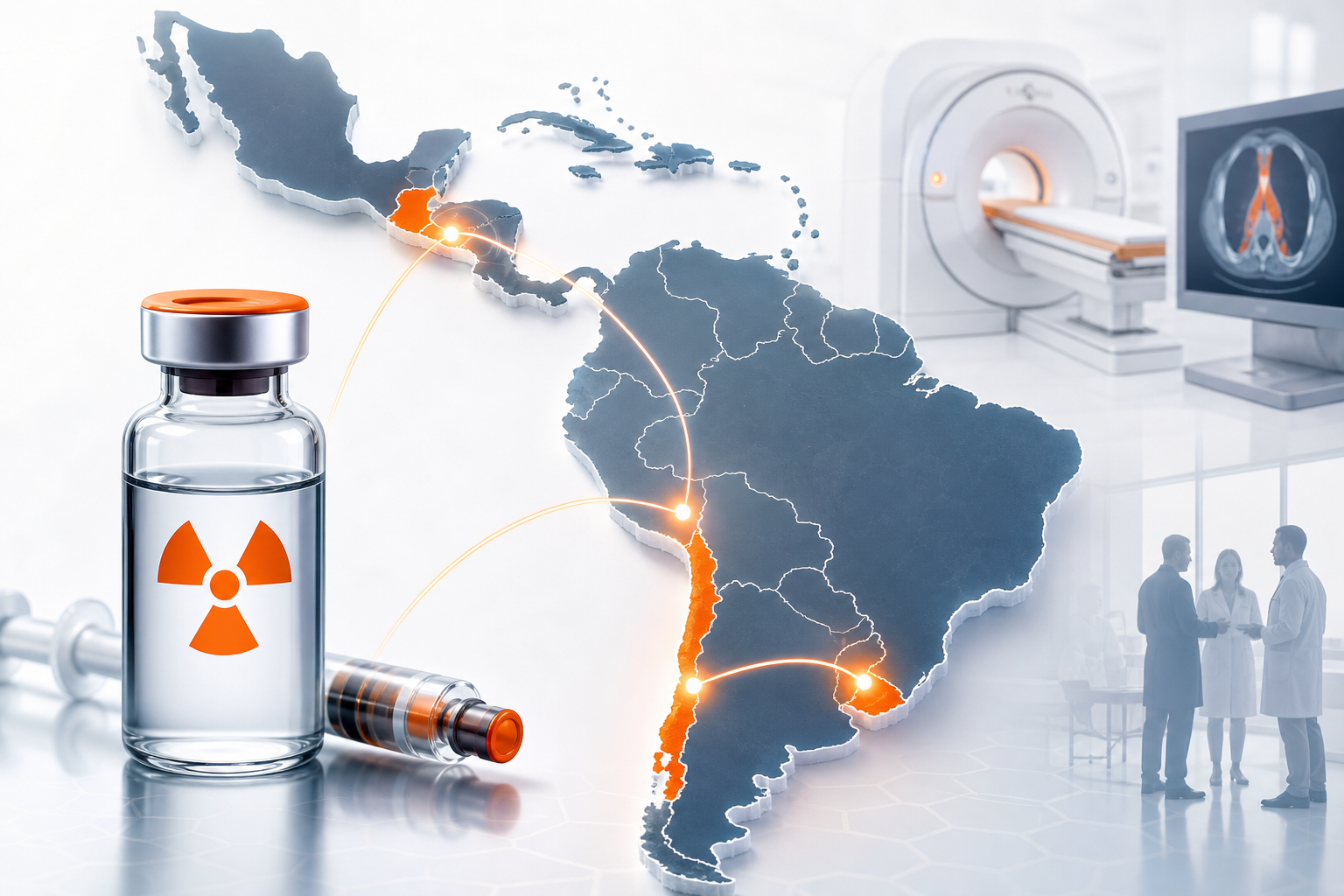
- Why Latin America Works for Radiopharmaceutical Development
- Regulatory Pathways by Jurisdiction
- Site Requirements for Radiopharmaceutical Trials
- Building a Submission-Ready Evidence Package
- Working with a CRO That Knows the Terrain
- Practical Steps Before You Commit to a Jurisdiction
- FAQs
- Start with the Right Infrastructure
Radiopharmaceutical development has moved fast. Lutetium-177 DOTATATE reshaped the neuroendocrine tumor space, Actinium-225 programs are advancing across multiple oncology indications, and Gallium-68 diagnostics have become standard of care in several markets. If you are running a radiopharmaceutical program today, the question is no longer whether to pursue early human data — it is where to pursue it without burning through runway while a U.S. or EU regulatory clock ticks down.
Latin America has become a serious answer to that question. Ethics and regulatory approvals in Panama, El Salvador, Chile, and the Dominican Republic are observed in 30 to 90 days, compared to 6 to 12 months at equivalent stages in the U.S. or EU. For a seed-to-Series-B sponsor with 18 months of runway and a board milestone tied to first human data, that gap is the difference between making the next funding round and missing it.
This article covers what you need to know before running a radiopharmaceutical clinical trial in Latin America: the regulatory pathways by jurisdiction, the site infrastructure requirements specific to radionuclide work, and the practical steps for building a submission-ready evidence package that holds up at FDA.
Why Latin America Works for Radiopharmaceutical Development
The appeal goes beyond speed. Latin American clinical populations are diagnostically naive to many novel radiolabeled compounds, which reduces confounding from prior treatment exposure. Patient enrollment rates at experienced oncology centers in the region tend to outpace U.S. sites for the same indications. The cost structure is also meaningfully different: per-patient costs in Panama run between $12,000 and $22,000 — a fraction of comparable U.S. trial costs.
The regulatory data generated in these markets is not a workaround. Under FDA 21 CFR 812.28, foreign clinical data collected under ICH-GCP and ISO 14155 standards can be accepted in IDE and IND submissions when the evidence package is structured correctly. A first-in-human dataset completed in Panama or Chile can feed directly into your U.S. regulatory strategy without running a parallel domestic trial first.
For radiopharmaceutical programs specifically, the combination of fast regulatory entry, experienced nuclear medicine infrastructure, and FDA-bridgeable data collection makes Latin America a practical first stop before a U.S. pivotal study.
Regulatory Pathways by Jurisdiction
Radiopharmaceuticals occupy a hybrid regulatory category across most Latin American markets — typically classified as either radiopharmaceutical drugs or radioactive medical devices, with the pathway depending on whether the compound is primarily diagnostic or therapeutic. Getting the classification right upfront saves months of back-and-forth with the relevant authority.
Panama: MINSA and CNBI
Panama's Ministry of Health (MINSA) and the National Bioethics Committee (CNBI) jointly govern clinical trial approvals. Radiopharmaceuticals fall under MINSA's pharmaceutical directorate, with CNBI providing parallel ethics review. The 30-to-90-day approval window reflects a well-established process for both drug and device sponsors.
Nuclear medicine infrastructure is concentrated in Panama City, where several sites have cyclotrons or radiopharmacy capabilities for Ga-68 production and established protocols for Lu-177 administration. Ac-225 programs require additional radiation safety documentation, but the regulatory framework accommodates them. Panama is also the most cost-transparent market in the region for trial budgeting, which is why per-patient benchmarks are most reliably cited there.
Chile: ISP and MINSAL
Chile's Institute of Public Health (ISP) and Ministry of Health (MINSAL) share jurisdiction over clinical trial approvals. Chile has one of the most developed nuclear medicine networks in South America, with PET/CT infrastructure at major academic medical centers in Santiago and several regional cities.
The ISP pathway for radiopharmaceuticals requires a dossier covering the investigational product's radiochemical characterization, dosimetry data, and radiation safety protocols. For Ga-68 diagnostics, ISP review tends to move faster because the compound class is well understood. For novel therapeutic isotopes like Ac-225, expect additional technical questions and plan for a documentation-heavy submission. Approval timelines are consistent with Panama's 30-to-90-day range, though novel radiopharmaceuticals can run toward the longer end.
El Salvador: SRS and CNEIS
El Salvador's Regulatory Health System (SRS) and the National Committee for Ethics in Health Research (CNEIS) manage clinical trial oversight. The market is smaller than Panama or Chile, but it has been used effectively for early feasibility studies where enrollment targets are modest. For radiopharmaceutical trials, the site network is more limited, and sponsors should confirm site-level radiation safety infrastructure before committing to El Salvador as a primary execution market for radionuclide therapeutics.
Dominican Republic
The Dominican Republic offers approval timelines comparable to Panama and El Salvador. For radiopharmaceutical development, it functions better as a secondary enrollment site than a primary execution market, given the current state of nuclear medicine infrastructure relative to Panama and Chile.
Site Requirements for Radiopharmaceutical Trials
Running a Lu-177, Ac-225, or Ga-68 trial is not the same as running a standard oncology drug or device study. The site infrastructure requirements are specific, and failing to qualify them upfront is one of the most common reasons radiopharmaceutical programs slip their timelines.
Radiopharmacy and Isotope Handling
Ga-68 diagnostic programs require either an on-site cyclotron or a reliable supply chain from a regional radiopharmacy. With a 68-minute half-life, the logistics of production-to-administration are tightly constrained. Sites in Panama City and Santiago have demonstrated this capability, but the specific supply arrangement for your compound needs to be confirmed before site selection is finalized.
Lu-177 programs require a licensed radiopharmacy capable of receiving, labeling, and dispensing the therapeutic compound. The roughly 6.6-day half-life provides more logistical flexibility than Ga-68, but the radiation safety infrastructure requirements are higher — dedicated hot labs, appropriate waste disposal protocols, and staff trained in therapeutic radiopharmaceutical administration are all necessary.
Ac-225 is the most demanding of the three. With a half-life of approximately 10 days and daughter isotopes requiring careful containment, Ac-225 programs need sites with advanced radiation safety programs, dosimetry expertise, and direct experience with alpha-emitting therapeutics. This narrows the qualified site pool in Latin America, but qualified sites do exist within bioaccess®'s 50-plus pre-qualified network, which was built specifically for this work.
Imaging Infrastructure
Most radiopharmaceutical trials require PET/CT or SPECT/CT imaging at defined protocol timepoints. Site qualification must confirm scanner availability, calibration standards, and image acquisition protocols that match your study's requirements. For multi-site trials, image standardization across sites is a protocol design consideration — not just an operations issue.
Chile's academic centers offer modern PET/CT infrastructure with experience in quantitative imaging for research protocols. Panama's imaging infrastructure is concentrated at a smaller number of sites, which affects how many sites can realistically be activated for a radiopharmaceutical study.
Radiation Safety and Regulatory Compliance
Every site running a radiopharmaceutical trial needs a radiation safety officer, documented radiation protection protocols, and a license to handle the specific isotopes in the protocol. In Latin America, radiation safety oversight typically falls under the national nuclear energy authority in addition to the health ministry — CCHEN in Chile, and the National Secretariat of Energy in Panama.
Site qualification should include a review of the site's current radiation safety license, the scope of isotopes covered, and prior experience with the specific compound class. This step cannot be skipped, and it should happen before ethics submission, not after.
Building a Submission-Ready Evidence Package
The goal of a Latin American radiopharmaceutical trial is not just to generate human data. It is to generate data your FDA regulatory team can use in an IND or IDE submission without repeating the study domestically.
That requires three things from the start: a protocol designed to ICH-GCP and ISO 14155 standards, a data management system that produces audit-ready records, and a regulatory strategy that keeps the U.S. pathway in view throughout execution.
Protocol Design Considerations
Radiopharmaceutical first-in-human protocols need to address dosimetry, safety monitoring, and imaging endpoints in ways that satisfy both the local regulatory authority and FDA's expectations for foreign clinical data. Dosimetry assessments are typically required at multiple timepoints, with the protocol specifying how that data will be collected, analyzed, and reported.
Stopping rules and dose escalation criteria need to be defined with the same rigor required for a U.S. IND submission. Local ethics committees in Panama and Chile are experienced with oncology protocols and will scrutinize these sections carefully.
Data Management and Audit Readiness
Electronic data capture systems used in Latin American radiopharmaceutical trials must meet FDA 21 CFR Part 11 requirements for electronic records — a non-negotiable condition for data destined for a U.S. submission. Data management plans should specify how imaging data, dosimetry calculations, adverse event records, and laboratory results will be captured, stored, and made available for FDA review.
FDA Bridgeability
Under 21 CFR 812.28, FDA can accept data from foreign clinical investigations conducted under conditions comparable to U.S. standards. For radiopharmaceutical programs, the evidence package needs to document the site's radiation safety infrastructure, principal investigator qualifications, GCP compliance of trial conduct, and the integrity of the data chain from collection to submission.
Structuring for FDA bridgeability is not something you retrofit at the end of the trial. It has to be designed into the program from the protocol development stage.
Working with a CRO That Knows the Terrain
Radiopharmaceutical development in Latin America is not a standard clinical operations project. The combination of isotope-specific site requirements, dual-authority regulatory pathways, and FDA bridgeability standards demands a team that has run these programs before.
bioaccess® operates dedicated radiopharmaceutical trial capability covering Lu-177, Ac-225, and Ga-68 programs across its 19-country Latin American and Caribbean footprint. The FIH-12 program covers all nine workstreams — from FDA Pre-Sub and IND/IDE pathway alignment through site activation, patient enrollment, data management, and delivery of a submission-ready evidence package — with a 12-month timeline guarantee on the program structure.
The 50-plus pre-qualified site network includes locations with confirmed nuclear medicine and radiopharmacy infrastructure. Site qualification for radiopharmaceutical trials goes beyond standard GCP readiness to include radiation safety licensing, isotope handling capability, and imaging protocol standardization.
Intake is capped at eight new programs per quarter — a reflection of the operational depth these programs require, not a volume model.
Practical Steps Before You Commit to a Jurisdiction
Before selecting a primary execution market for your radiopharmaceutical trial, work through these questions:
Isotope logistics. What is the half-life of your compound, and what does that require from the site's radiopharmacy? Can the supply chain support your dosing schedule across the sites you plan to activate?
Site qualification scope. Does the site hold a radiation safety license that covers your specific isotope? Has the principal investigator administered this compound class before, or would this be their first experience with it?
Regulatory classification. How will the local authority classify your compound? Diagnostic and therapeutic radiopharmaceuticals follow different pathways in most jurisdictions, and getting the classification wrong at submission adds weeks to the review.
FDA strategy alignment. Is your protocol designed to produce data FDA will accept under 21 CFR 812.28? Has your regulatory counsel reviewed it against FDA's expectations for foreign clinical data before you submit to the local authority?
Timeline against runway. If approvals run toward the longer end of the 30-to-90-day observed range, does your program timeline still hold against your next funding milestone?
These are not questions you answer once and move on. They should be revisited at each stage of program design, because the answers affect site selection, protocol design, and regulatory submission strategy simultaneously.
FAQs
What regulatory authorities govern radiopharmaceutical clinical trials in Latin America?
It depends on the jurisdiction. Panama uses MINSA and CNBI. Chile uses ISP and MINSAL. El Salvador uses SRS and CNEIS. Beyond health ministry oversight, radiation safety for nuclear compounds typically falls under a separate national nuclear authority — CCHEN in Chile, the National Secretariat of Energy in Panama. Sponsors need to satisfy both sets of requirements before a trial can begin.
Can data from a Latin American radiopharmaceutical trial be used in a U.S. IND submission?
Yes, when the trial is conducted under ICH-GCP and ISO 14155 standards and the evidence package is structured per FDA 21 CFR 812.28. The data is not automatically accepted — it must be presented in a format that documents site qualifications, GCP compliance, data integrity, and the comparability of trial conditions to U.S. standards. Structuring for FDA bridgeability needs to happen at the protocol design stage, not after data collection is complete.
Which Latin American markets have the strongest nuclear medicine infrastructure for radiopharmaceutical trials?
Panama and Chile are the most developed for radiopharmaceutical trial execution. Chile has multiple academic centers with PET/CT infrastructure and experience in quantitative imaging research. Panama has established radiopharmacy capabilities for Ga-68 and Lu-177 programs in Panama City. Ac-225 programs require more selective site qualification in any market due to alpha-emitter handling requirements.
How long does regulatory approval take for a radiopharmaceutical trial in Panama or Chile?
Ethics and regulatory approvals in both markets are observed in 30 to 90 days. These are observed outcomes based on completed submissions, not a contractual guarantee from the health authorities. Novel radiopharmaceuticals — particularly Ac-225 programs — may prompt additional technical questions that push review toward the longer end of that range.
What site infrastructure is required specifically for Lu-177 therapeutic trials?
Sites need a licensed radiopharmacy capable of receiving, labeling, and dispensing Lu-177, along with dedicated hot lab space, radioactive waste disposal systems, and staff trained in therapeutic radiopharmaceutical administration. Dosimetry expertise and SPECT/CT imaging capability are also required for most Lu-177 protocols.
What makes Ac-225 trials more complex than Lu-177 or Ga-68 programs?
Ac-225 is an alpha emitter with daughter isotopes that require careful containment and monitoring. Radiation safety infrastructure requirements are higher than for Lu-177 or Ga-68, and fewer sites have the experience and licensing to handle it. Site qualification for an Ac-225 program needs to include a detailed review of the site's radiation protection program, dosimetry capabilities, and prior experience with alpha-emitting compounds.
How does a CRO's role differ in a radiopharmaceutical trial compared to a standard device or drug study?
A CRO running a radiopharmaceutical trial needs to manage isotope-specific site qualification, dual-authority regulatory submissions covering both health and radiation safety, imaging protocol standardization across sites, and dosimetry data management — on top of standard GCP-compliant trial operations. The operational complexity is higher, and the consequences of site qualification gaps are more severe because isotope logistics cannot be improvised mid-study.
Start with the Right Infrastructure
Radiopharmaceutical development in Latin America is achievable, and the regulatory speed advantage is real. But it requires more upfront site qualification work, more specific regulatory strategy, and more careful protocol design than a standard early feasibility study.
If you are 12 to 24 months from needing first human data for a Lu-177, Ac-225, or Ga-68 program, the time to map the pathway is now — not after your IND is filed. Visit bioaccessla.com to get a preliminary country route and timeline estimate for your program.
WordPress Category: Navigating Regulatory Landscapes in Latin America
Leave a Reply