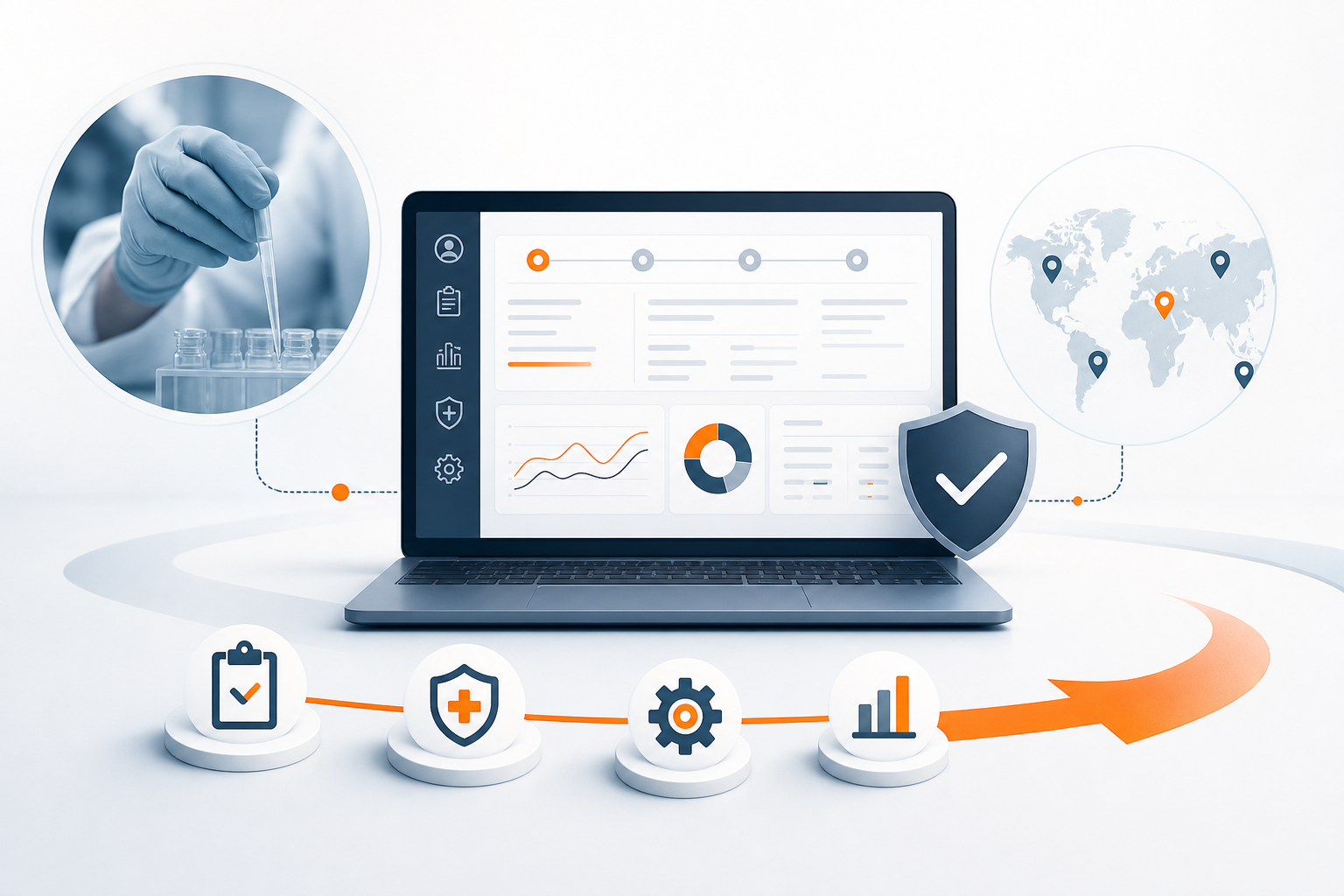
- Why EDC Selection Looks Different for FIH Studies
- The Core Requirements for a FIH-Ready EDC
- What to Evaluate Beyond the Feature List
- Platforms Commonly Used in Early-Phase Trials
- The Biggest Mistakes Sponsors Make with EDC Selection
- How EDC Fits Into a FIH Program
- FAQs
Your electronic data capture system isn't a back-office detail when you're running a first-in-human trial. It's the infrastructure that determines whether your dataset is FDA-submittable or a rework project. Pick the wrong platform and you'll spend months cleaning data that should have been clean from day one.
This guide covers what actually matters when selecting an EDC for a FIH study — not a 200-site Phase III, but an early-feasibility or first-in-human trial where your team is lean, your timeline is tight, and the data package you generate needs to hold up under FDA scrutiny.
Why EDC Selection Looks Different for FIH Studies
Most EDC comparisons are written for large-scale trials with dedicated IT teams, established data management departments, and long build timelines. FIH studies operate under different conditions.
You're typically working with a small investigator team, a limited subject count, and a protocol that may still be evolving close to site activation. You need a platform that configures quickly, doesn't require months of validation work before you can collect a single data point, and produces outputs that map cleanly to your regulatory submission format — whether that's an IDE, a 510(k) package, or an IND.
The compliance bar doesn't change. ICH-GCP standards apply regardless of study size. If your trial runs outside the US, FDA 21 CFR 812.28 governs how that foreign clinical data is accepted. Your EDC needs to support audit trails, access controls, and data integrity standards that will survive a regulatory review.
The Core Requirements for a FIH-Ready EDC
21 CFR Part 11 Compliance
This is non-negotiable. Any EDC used in a trial intended to support an FDA submission must meet 21 CFR Part 11 requirements for electronic records and electronic signatures — audit trails for every data entry and modification, role-based access controls, and validated software with documented testing.
If a vendor can't provide a current validation package and a 21 CFR Part 11 compliance statement, move on.
ISO 14155 Compatibility for Medical Device Trials
Medical device FIH studies follow ISO 14155, the international standard for clinical investigation of medical devices. Your EDC needs to support data collection structures that align with this standard: adverse event capture, device accountability, protocol deviation tracking, and investigator assessments that map to the endpoints defined in your clinical investigation plan.
Not every EDC vendor has experience with device trials. Many are built primarily for drug studies, where the data architecture looks different. Ask specifically about ISO 14155 support and request examples of prior device study builds.
Fast Configuration and Startup
A FIH study on a 12-month timeline cannot absorb a 16-week EDC build. The best platforms for early-phase device and biopharma studies offer library-based form building, pre-validated study templates, and configuration timelines measured in weeks. Look for vendors who can demonstrate how quickly they activate a study from a finalized protocol — and get a realistic timeline in writing before you sign.
Multi-Site and Multi-Country Data Collection
If your trial runs across sites in Panama, Colombia, El Salvador, Chile, or the Dominican Republic, your EDC needs to support multi-language data entry, local time zone handling, and site-level access controls. Data collected across different regulatory jurisdictions still needs to flow into a single, clean, centralized database.
This is especially relevant when site staff are working in Spanish and your data management team is reviewing in English. The platform needs to handle that workflow without introducing transcription risk.
Regulatory Submission Export Formats
Your EDC should export data in CDISC CDASH and SDTM formats — the standards FDA expects for data submissions. If it can't produce clean SDTM datasets, your data management team will be doing manual conversions, which adds time, cost, and the risk of errors entering your submission package. Confirm the export formats before you commit to a platform.
What to Evaluate Beyond the Feature List
Vendor Experience with Early-Phase Studies
A vendor's reference list matters. Ask how many FIH or Phase I studies they've supported, and specifically whether any involved medical devices or international sites. A platform built primarily for large Phase III oncology trials may not have the configuration flexibility or support model that works for a 15-subject FIH feasibility study.
Data Management Support Model
Some EDC vendors sell software only. Others offer managed data management services alongside the platform. For a startup running its first FIH trial, a fully managed model often makes more sense than purchasing a license and building out your own DM team. Understand what's included in the contract and what's billed separately before you sign.
Integration with Your CRO’s Workflow
If you're working with a CRO that manages data management as part of its engagement, your EDC selection may be partially dictated by that CRO's existing infrastructure. This is worth discussing early. A CRO with validated workflows built around a specific EDC platform will execute faster and with fewer errors than one adapting to an unfamiliar system mid-study.
At bioaccess®, data management is one of the nine workstreams covered under the FIH-12™ program. EDC setup, data monitoring, and preparation of the final evidence package are handled by the same team managing your protocol, your sites, and your regulatory submissions — not handed off to a separate vendor.
Platforms Commonly Used in Early-Phase Trials
This isn't an exhaustive market review, and the right choice depends on your specific protocol, budget, and CRO relationship. That said, a few platforms appear consistently in early-phase and FIH study contexts.
Medidata Rave is the most widely deployed EDC in clinical research globally. It has strong 21 CFR Part 11 compliance infrastructure and broad regulatory acceptance. The tradeoff is configuration complexity and cost — it's better suited to sponsors with experienced data management teams or CROs with deep Medidata expertise.
REDCap is widely used in academic and early-phase settings for its low cost and fast setup. It can be configured for 21 CFR Part 11 compliance, but that requires careful validation work. It's not a commercial EDC and lacks some of the enterprise support features larger trials need. For a lean FIH study with a strong data management team, it can work — but the validation burden needs to be managed carefully when the data is intended to support an FDA submission.
Veeva Vault EDC has gained adoption in recent years, particularly in biopharma. It integrates well with other Veeva modules and has strong audit trail and compliance features. Configuration is generally faster than Medidata for straightforward protocols.
Castor EDC is built specifically for early-phase and academic trials, with a faster setup model and strong multi-language support. It's used in international studies and has a compliance framework that supports 21 CFR Part 11. For FIH studies with international sites, it's worth evaluating.
OpenClinica has a strong compliance pedigree, particularly in studies requiring CDISC output. It has both a commercial and an open-source version; the commercial version includes the validation documentation needed for regulatory submissions.
The Biggest Mistakes Sponsors Make with EDC Selection
Selecting based on price alone. The cheapest platform often carries the highest total cost once you factor in configuration time, data cleaning, and conversion work at submission. A platform that produces clean SDTM output from day one is worth more than one that requires manual post-processing.
Treating EDC as a standalone decision. Your EDC choice affects your CRO, your data management team, your regulatory timeline, and your submission package. Make the decision in context, not in isolation.
Underestimating the validation requirement. Every EDC used in a regulated trial needs to be validated. If the platform isn't already validated for your use case, that work takes time and costs money. Build it into your timeline from the start.
Locking in a platform before your protocol is finalized. EDC configuration is driven by your data collection requirements, which come from your protocol. Starting the build before the protocol is stable leads to expensive amendments and delays.
How EDC Fits Into a FIH Program
A FIH study generates the foundational dataset your entire regulatory pathway depends on. The EDC is the system that captures, validates, and stores that data. Set it up correctly and your final data package is clean, audit-ready, and formatted for submission. Get it wrong and you're looking at data remediation that can delay your IDE or 510(k) by months.
The most efficient path is to select your EDC as part of your overall FIH program design — not as a separate procurement. When your CRO manages data management as an integrated workstream alongside protocol development, site activation, and regulatory submissions, the EDC configuration is built to match the protocol from the start.
That integration is part of what makes a structured FIH program different from assembling vendors independently. If you're evaluating CRO options, it's worth understanding how each handles data management and what EDC infrastructure they bring to the engagement.
FAQs
What is an EDC system in clinical trials?
An electronic data capture (EDC) system is software used to collect, manage, and store clinical trial data in a structured, validated digital format. It replaces paper case report forms and provides the audit trail and access controls required for regulatory submissions.
Does my EDC need to be 21 CFR Part 11 compliant for a FIH study?
Yes. Any EDC used in a trial intended to support an FDA submission must comply with 21 CFR Part 11, which governs electronic records and electronic signatures. This includes audit trails, role-based access, and validated software with documented testing.
Can I use REDCap for a trial intended to support an FDA submission?
REDCap can be configured to meet 21 CFR Part 11 requirements, but it requires careful validation work that the sponsor or CRO must manage. It doesn't come with built-in regulatory validation packages the way commercial platforms do, so the compliance burden is higher.
How long does EDC configuration typically take for a FIH study?
For a straightforward FIH protocol, commercial EDCs with template libraries can typically be configured in four to eight weeks. More complex protocols or custom builds take longer. Factor this into your overall study startup plan.
What data export formats does FDA expect for EDC submissions?
FDA expects CDISC-compliant formats — specifically CDASH for data collection standards and SDTM for submission datasets. Your EDC should produce these formats directly. If it can't, your data management team will need to perform conversions, which adds time and risk.
Does the EDC need to support multiple languages for international FIH studies?
If your trial runs at sites where staff work in a language other than English, multi-language data entry support is important. For studies conducted in Latin American countries, site staff typically work in Spanish. Clean data collection in the local language reduces transcription errors and simplifies data review.
How does EDC selection affect my FDA submission timeline?
A well-configured EDC that produces clean, CDISC-compliant data shortens the time between last patient visit and a submission-ready data package. A poorly configured one can add months of cleaning and reformatting. EDC selection is a direct input to your regulatory timeline — not a separate operational decision.
Choosing the right EDC for a FIH study comes down to one question: will this platform produce a clean, FDA-submittable dataset within your timeline? Get the compliance infrastructure right, align the platform with your protocol and your CRO's workflow, and treat EDC selection as part of your overall program design from day one.
If you're planning a first-in-human trial and want to understand how data management fits into a structured FIH program, bioaccess® manages all nine workstreams under one engagement — including EDC setup and data management — across its network of sites in Panama, Colombia, El Salvador, Chile, and the Dominican Republic.
Leave a Reply