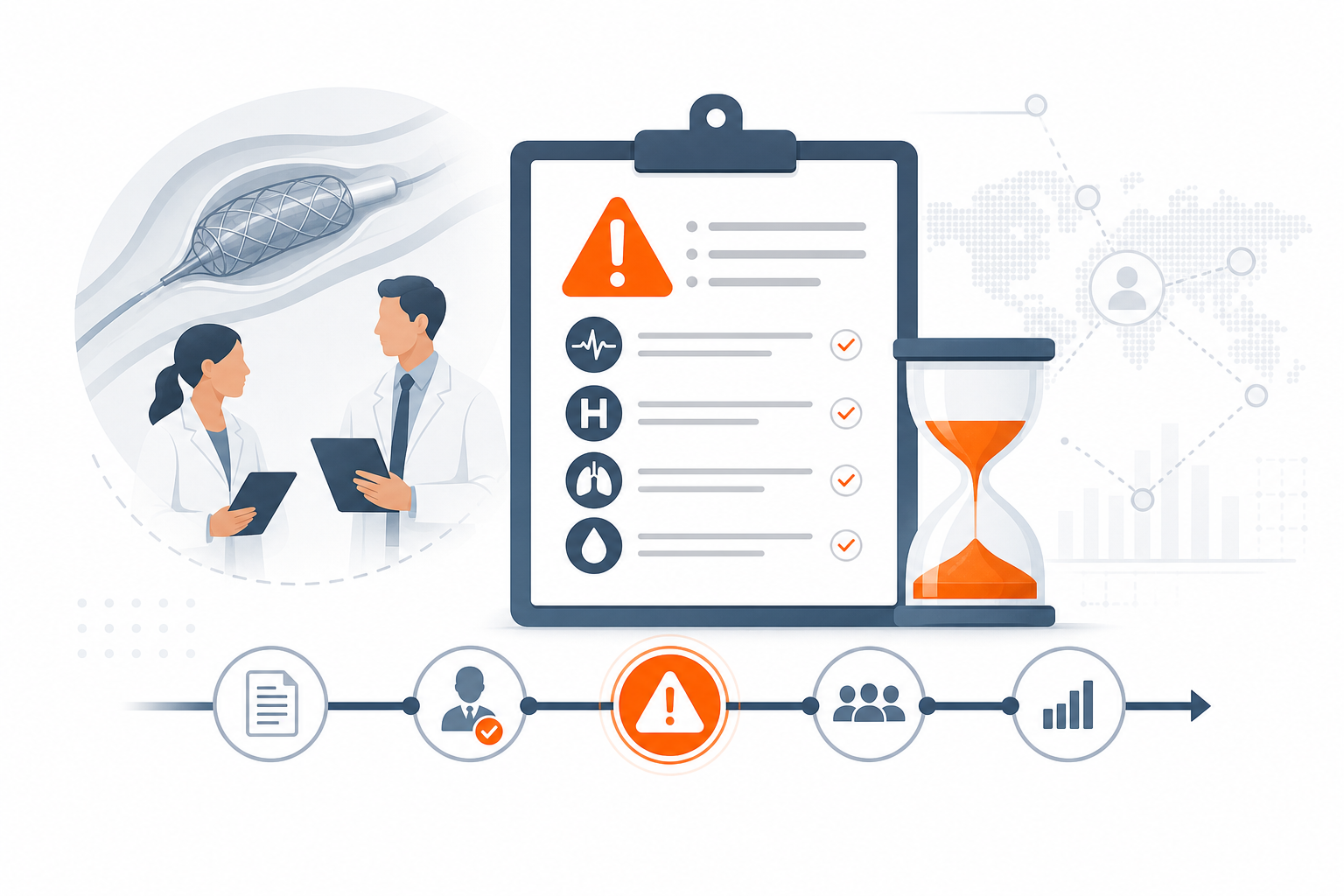
- The Regulatory Definition of a Serious Adverse Event
- SAE vs. Adverse Event: Understanding the Distinction
- Who Is Responsible for SAE Reporting?
- SAE Reporting Timelines for Medical Device Trials
- What Sponsors Must Do When an SAE Occurs
- Step 1: Receive and Timestamp the Initial Report
- Step 2: Assess Causality and Expectedness
- Step 3: Determine Whether Expedited Reporting Is Required
- Step 4: Notify the FDA and Ethics Committee
- Step 5: Prepare the SAE Narrative
- Step 6: Follow Up Until Resolution
- Step 7: Update the Investigational Plan or Device Description If Warranted
- SAE Documentation in the Trial Master File
- SAE Reporting in Latin American Trials
- SAE Reporting Across Device Types and Trial Phases
- Common SAE Reporting Mistakes Sponsors Make
- How a CRO Manages SAE Obligations in FIH Studies
- FAQs
- Conclusion
A serious adverse event (SAE) in a medical device trial is not a paperwork formality. It is one of the most consequential safety signals your study will generate, and the speed, completeness, and accuracy of your response directly shapes your regulatory standing, your trial timeline, and the integrity of your eventual FDA submission.
This article covers the regulatory definition of an SAE, how it differs from an ordinary adverse event and a UADE, the reporting timelines that apply under FDA 21 CFR 812 and ICH-GCP, and the specific obligations that fall on sponsors when an SAE occurs during a medical device study — including trials conducted in Latin America.
The Regulatory Definition of a Serious Adverse Event
The FDA defines a serious adverse event as any untoward medical occurrence in a clinical trial participant that results in one or more of the following outcomes:
- Death
- Life-threatening condition (the patient was at immediate risk of death at the time of the event, not that the event might theoretically cause death later)
- Inpatient hospitalization or prolongation of existing hospitalization
- Persistent or significant disability or incapacity
- Congenital anomaly or birth defect
- Important medical event that, based on appropriate medical judgment, may jeopardize the patient and may require medical or surgical intervention to prevent one of the outcomes listed above
That sixth category is intentionally broad. It exists to capture events that do not technically satisfy the first five criteria but are clinically significant enough to warrant reporting. Regulatory reviewers and Ethics Committees (ECs) expect sponsors to apply judgment here — not just run through a checklist.
The ICH-GCP E6(R2) guideline uses the same framework. That consistency matters for sponsors running first-in-human (FIH) studies outside the United States: whether your trial operates under an IDE in the US or under a protocol governed by ISO 14155 in Panama, Colombia, or Chile, the seriousness criteria are the same.
SAE vs. Adverse Event: Understanding the Distinction
An adverse event (AE) is any unintended medical occurrence in a clinical trial participant, regardless of whether it is related to the investigational device. It does not have to be serious to be documented. Every AE goes into the case report form.
An SAE is a subset of adverse events that meets one or more of the seriousness criteria above. Every SAE is an adverse event, but not every adverse event is an SAE. That distinction triggers different documentation requirements, different reporting timelines, and different regulatory notifications.
A third category applies specifically to device trials: the unanticipated adverse device effect (UADE). Under FDA 21 CFR 812, a UADE is any serious adverse effect on health or safety, or any life-threatening problem or death caused by or associated with a device, where that effect, problem, or death was not previously identified in nature, severity, or degree of incidence in the investigational plan or application. UADEs carry stricter reporting obligations than standard SAEs and require immediate action from both the investigator and the sponsor.
A practical example
A patient in a cardiovascular device trial develops a minor rash at the implant site. That is an adverse event. It gets documented in the case report form, but it does not trigger an expedited SAE report.
Three days later, the same patient is hospitalized with a suspected device-related infection requiring surgical intervention. That hospitalization, combined with the need for surgical management, meets the SAE threshold. Reporting obligations activate immediately. If the infection was not identified as a potential risk in the investigational plan, the event may also qualify as a UADE — which triggers an even shorter reporting clock.
Who Is Responsible for SAE Reporting?
Responsibility is shared, but it is not equal.
The principal investigator (PI) at the clinical site is responsible for identifying the event, completing the initial SAE report form, assessing causality, and notifying the sponsor within the timeframe specified in the protocol — typically within 24 hours of becoming aware of the event.
The sponsor then evaluates the event, determines whether it meets expedited reporting thresholds, and submits the appropriate report to the FDA and, where applicable, to the Ethics Committee and local health authority. In a multi-site trial, the sponsor is also responsible for notifying all other active investigators of any SAE that could affect the safety of their patients.
In a first-in-human study, the sponsor is often a lean startup team. That makes the CRO's role in SAE management especially important. A CRO that owns the pharmacovigilance workstream should have established standard operating procedures (SOPs) for SAE intake, causality assessment, narrative writing, and regulatory submission before the first patient is enrolled — not after the first event occurs.
SAE Reporting Timelines for Medical Device Trials
Timelines differ depending on the regulatory framework governing your study. Getting these wrong is one of the most common compliance failures in early-stage device trials.
FDA 21 CFR 812: IDE Studies
Under FDA 21 CFR 812, the sponsor must report a UADE to the FDA and all reviewing IRBs or ECs within 10 working days of first receiving notice of the effect. For device malfunctions that could cause or contribute to a serious injury if they were to recur, the same 10-working-day window applies.
SAEs that are not UADEs are generally reported in the annual progress report unless the IDE protocol specifies expedited reporting for certain event types. Many sponsors build protocol language requiring expedited SAE reporting for all serious events regardless of UADE status — a defensible and recommended approach for first-in-human studies.
FDA 21 CFR 312: IND Studies (Biopharma Context)
For drug and biopharma trials under an IND, the FDA requires expedited reporting of unexpected serious adverse reactions within 7 calendar days if fatal or life-threatening, and within 15 calendar days for other unexpected serious adverse reactions. This distinction matters for combination product sponsors, who must determine which regulatory framework governs their primary mode of action.
ICH-GCP E6(R2) Baseline
ICH-GCP E6(R2) requires the investigator to report all SAEs to the sponsor immediately — defined in most protocols as within 24 hours of awareness. The sponsor then has its own clock for regulatory authority notification. This baseline applies across all ICH-member jurisdictions and is the standard incorporated into ISO 14155, the international standard for medical device clinical investigations.
What Sponsors Must Do When an SAE Occurs
A structured SAE response process is not optional. The following steps reflect the obligations that apply under FDA and ICH-GCP frameworks.
Step 1: Receive and Timestamp the Initial Report
The moment the sponsor receives an SAE report from the investigator, the regulatory clock starts. Document the date and time of receipt. This timestamp is the reference point for every subsequent reporting deadline.
Step 2: Assess Causality and Expectedness
Causality assessment determines whether the event is related to the investigational device or procedure. Expectedness assessment determines whether the event was previously identified in the investigational plan. Both assessments drive the reporting pathway.
Causality is typically assessed on a scale: unrelated, unlikely, possible, probable, or definite. For device trials, the PI's causality assessment is primary, but the sponsor has the right and obligation to form an independent medical judgment.
Step 3: Determine Whether Expedited Reporting Is Required
If the event is a UADE, the 10-working-day clock under 21 CFR 812 is already running. If the event is an SAE that is not a UADE but is unexpected and possibly device-related, review your protocol language to determine whether expedited reporting applies. When in doubt, report expeditiously. Regulatory reviewers treat proactive reporting as a sign of sponsor competence.
Step 4: Notify the FDA and Ethics Committee
For IDE studies, UADEs go to the FDA via MedWatch Form 3500A or the equivalent electronic submission pathway. The reviewing IRB or EC must receive notification simultaneously. For multi-site studies, all other investigators must also be notified of any SAE that could affect patient safety across sites.
For Latin American trials, local health authority notification requirements vary by country. In Colombia, INVIMA has its own pharmacovigilance reporting requirements. In Brazil, ANVISA maintains a national pharmacovigilance system. In Panama, notifications go through MINSA/CNBI. Sponsors running multi-country studies need country-specific SAE notification SOPs — not a single global template.
Step 5: Prepare the SAE Narrative
The SAE narrative is the written account of the event: the patient's relevant medical history, the sequence of events, the clinical management, the outcome, and the sponsor's causality and expectedness assessment. It must be clear, factual, and free of speculation. Regulatory reviewers read these narratives carefully. A narrative that contradicts the case report form data is a significant audit finding.
Step 6: Follow Up Until Resolution
An SAE report is not closed at initial submission. The sponsor must follow up with the investigator until the event resolves or stabilizes and submit follow-up reports as new information becomes available. Unresolved SAEs at study close must be addressed in the clinical study report.
Step 7: Update the Investigational Plan or Device Description If Warranted
If an SAE reveals a risk that was not previously identified, the sponsor must evaluate whether the investigational plan, informed consent documents, or device description require amendment. In some cases, a protocol amendment and re-consent of enrolled patients will be required before the study can continue.
SAE Documentation in the Trial Master File
Every SAE must be documented in the Trial Master File (TMF) in a way that allows a regulatory reviewer to reconstruct the full timeline of events from initial report to resolution. Required documents include:
- The completed SAE report form from the investigator
- The sponsor's causality and expectedness assessment
- All regulatory authority notifications and acknowledgments
- Ethics Committee notifications and responses
- The SAE narrative and any follow-up narratives
- Correspondence with the investigator related to the event
- Any protocol amendments or informed consent updates triggered by the event
For sponsors planning an IDE or IND submission, the SAE section of the clinical study report is one of the most scrutinized components. Gaps in TMF documentation, missing follow-up reports, or inconsistencies between the narrative and the case report form data are among the most common deficiencies cited in FDA review letters.
SAE Reporting in Latin American Trials
Running a first-in-human study in Latin America does not change the FDA's SAE reporting requirements for the sponsor. Data collected under ISO 14155 and structured per FDA 21 CFR 812.28 is accepted for US IDE and IND submissions. The SAE reporting obligations that apply to your IDE remain in force regardless of where the study is conducted.
What changes is the addition of local reporting obligations. Each country where the study is active has its own pharmacovigilance requirements, and those requirements must be built into the protocol and the CRO's SAE management SOPs before the first patient is enrolled.
In Colombia, INVIMA requires sponsors to report serious adverse events through its national pharmacovigilance system, with timelines that align broadly with ICH-GCP but include country-specific form requirements. In Brazil, ANVISA's pharmacovigilance framework requires notification of serious adverse reactions to investigational products within defined timeframes. In Panama, MINSA/CNBI governs trial oversight, and SAE notifications must go through the appropriate ministry channel.
For a sponsor running a multi-country Latin American FIH study, the practical implication is that your CRO needs active, working relationships with each of these regulatory bodies — not just knowledge of the rules. bioaccess® maintains live regulatory authority integrations with MINSA/CNBI in Panama, ISP/MINSAL in Chile, and SRS/CNEIS in El Salvador, which means SAE notification pathways are established before the study opens, not built in response to an event.
The Cook Group multi-site FIH study in Colombia illustrates what this looks like in practice: a complex, multi-site program with 142-plus INVIMA regulatory submissions managed, requiring disciplined safety reporting infrastructure across an extended enrollment period. Similarly, the Avantec Vascular multi-country LATAM FIH program involved coordinated regulatory management across multiple Latin American jurisdictions, where SAE reporting obligations ran in parallel across country-specific frameworks.
One important note for sponsors: the 30-to-90-day ethics and regulatory approval window observed in participating Latin American countries reflects the time to study activation, not a compressed safety standard. Once a study is active, the same rigorous SAE reporting obligations apply as in any FDA-regulated trial.
SAE Reporting Across Device Types and Trial Phases
SAE reporting obligations apply from first-in-human through pivotal trials, but the risk profile and reporting volume typically differ by phase and device type.
In a first-in-human or early feasibility study (EFS), the patient population is small, the device is unproven in humans, and every SAE carries heightened significance. Regulators expect more conservative causality assessments and lower thresholds for protocol amendments in early-phase studies. The Establishment Labs LATAM clinical program, which generated clinical evidence supporting FDA PMA approval, demonstrates that a rigorous safety reporting infrastructure in early Latin American studies can translate directly into a submission-ready evidence package.
For implantable and long-term devices, SAE follow-up obligations extend well beyond the active treatment period. Sponsors must define in the protocol how long post-procedure follow-up continues and what constitutes a reportable event during that window.
For combination products, sponsors must determine at the outset which regulatory framework governs SAE reporting. A device with a drug or biologic component may trigger both 21 CFR 812 and 21 CFR 312 obligations, and the timelines differ.
Radiopharmaceutical trials involving compounds such as Lu-177, Ac-225, or Ga-68 add another layer: radiation exposure events and dosimetry deviations may require reporting under both device and drug frameworks and radiation safety regulations, depending on the jurisdiction.
Common SAE Reporting Mistakes Sponsors Make
These are the patterns that generate FDA deficiency letters and audit findings most often in early-phase device trials.
Missing the timestamp on receipt. The regulatory clock starts when the sponsor receives the report — not when the sponsor decides to act on it. Sponsors that cannot demonstrate when they received the initial SAE report have no defensible basis for their reporting timeline.
Conflating causality with expectedness. These are two separate assessments. An event can be device-related (causality: probable) but expected (listed in the investigational plan). An event can be unexpected but unrelated to the device. Conflating the two leads to incorrect reporting pathway decisions.
Closing SAE reports before resolution. Regulators expect follow-up reports until the event resolves or the sponsor can document a stable, chronic outcome. SAE reports closed at initial submission with no follow-up documentation are a common audit finding.
Using a single global SAE template for multi-country studies. Country-specific pharmacovigilance requirements in Colombia, Brazil, Panama, and other Latin American markets differ from each other and from the FDA's requirements. A single template that satisfies one authority may not satisfy another.
Failing to notify all investigators in multi-site studies. When an SAE occurs at one site and could affect patient safety at other active sites, all investigators must be notified. Treating SAE notification as a bilateral exchange between sponsor and reporting site does not meet the obligation.
Delayed narrative preparation. The SAE narrative is often treated as a post-hoc documentation task. In practice, it should be drafted as close to the event as possible, while clinical details are current and the investigator is available for follow-up questions. Narratives written weeks after the event are more likely to contain inconsistencies.
Not updating the informed consent after a new risk is identified. If an SAE reveals a risk not previously disclosed to patients, the sponsor must evaluate whether re-consent is required. Failing to do so is both a regulatory violation and an ethical one.
How a CRO Manages SAE Obligations in FIH Studies
For a startup sponsor running its first clinical study, the SAE management workstream is one of the highest-risk operational areas. The obligations are time-sensitive, technically complex, and span multiple regulatory authorities simultaneously in a multi-country study.
A CRO that owns this workstream end-to-end should have: established SAE intake SOPs with documented receipt timestamps; trained clinical monitors who can assess causality in real time; regulatory affairs staff with direct relationships with each country's health authority; and a narrative writing process that produces clean, consistent documentation ready for the TMF and the eventual clinical study report.
bioaccess® structures all studies under ISO 14155 and FDA 21 CFR 812.28 so that safety data collected in Latin American trials is accepted for US IDE and IND submissions without rework. The Hasten/Ampcare program in Mexico, which navigated the COFEPRIS-04-050 abbreviated pathway, illustrates how country-specific regulatory relationships and established SOPs reduce the operational burden on a startup sponsor when safety events require rapid regulatory action.
For sponsors planning a first-in-human study, understanding your SAE reporting obligations before the protocol is finalized is not just good practice. It is the difference between a study that generates a submission-ready evidence package and one that generates a deficiency letter. Learn more about how bioaccess® structures FIH programs for FDA-submissible outcomes at bioaccessla.com.
FAQs
What is a serious adverse event (SAE) in a medical device trial?
A serious adverse event is any untoward medical occurrence in a trial participant that results in death, a life-threatening condition, inpatient hospitalization or prolongation of hospitalization, persistent or significant disability, a congenital anomaly, or an important medical event requiring intervention to prevent one of those outcomes. The definition applies under FDA 21 CFR 812 and ICH-GCP E6(R2).
What is the difference between an SAE and a UADE?
An SAE is defined by the seriousness of the outcome to the patient. A UADE (unanticipated adverse device effect) is defined by whether the effect was previously identified in the investigational plan. A UADE is always serious, but an SAE is not automatically a UADE. UADEs carry a 10-working-day reporting deadline to the FDA under 21 CFR 812, which is stricter than the standard SAE reporting timeline for IDE studies.
How quickly must a sponsor report an SAE to the FDA in a device trial?
For UADEs under an IDE, the sponsor must notify the FDA and all reviewing IRBs or Ethics Committees within 10 working days of first receiving notice of the effect. For SAEs that are not UADEs, the protocol typically governs the timeline, though many sponsors build expedited reporting requirements into their protocols for all serious events.
Do SAE reporting obligations change when a trial is conducted in Latin America?
The FDA's SAE reporting requirements for the sponsor remain the same regardless of where the study is conducted. What changes is the addition of local pharmacovigilance reporting obligations in each country where the study is active. Colombia (INVIMA), Brazil (ANVISA), Panama (MINSA/CNBI), and other Latin American jurisdictions each have their own notification requirements and timelines that must be addressed in the protocol and CRO SOPs.
Is Latin American SAE data accepted by the FDA for IDE and IND submissions?
Yes, provided the data is collected under ISO 14155 and structured per FDA 21 CFR 812.28. Data collected under these standards in Latin American trials is accepted for US IDE and IND submissions without rework.
Who is responsible for SAE reporting in a CRO-managed trial?
The principal investigator at the site is responsible for identifying the event and notifying the sponsor, typically within 24 hours. The sponsor is responsible for causality and expectedness assessment, regulatory authority notification, Ethics Committee notification, and follow-up reporting until resolution. In a CRO-managed study, the CRO typically owns the SAE management workstream on the sponsor's behalf, but the sponsor retains ultimate regulatory responsibility.
What happens if an SAE reveals a risk not previously identified in the investigational plan?
The sponsor must evaluate whether the investigational plan, informed consent documents, or device description require amendment. If a new risk is identified, a protocol amendment and re-consent of enrolled patients may be required before the study can continue. The event may also qualify as a UADE, triggering the 10-working-day FDA notification requirement.
Conclusion
SAE reporting in a medical device trial is a time-sensitive, multi-authority obligation that begins the moment the sponsor receives the initial report and does not close until the event resolves. For startup sponsors running first-in-human studies in Latin America, that obligation runs in parallel across the FDA and each country's local pharmacovigilance framework.
Getting this right requires established SOPs, active regulatory relationships, and a CRO that treats SAE management as a core workstream — not an afterthought. Structure your safety reporting infrastructure before the first patient is enrolled. The evidence package you submit to the FDA will reflect every decision you made along the way.
Leave a Reply