- What Makes a Device Class II
- The 510(k) Pathway: Core Mechanics
- When Clinical Data Is Required for Class II
- Class II vs. Class III: Where the Line Falls
- Special Controls and What They Actually Require
- The IDE Question for Class II Studies
- Class II Clinical Strategy: The LATAM Acceleration Option
- 510(k) Submission: What FDA Reviews
- De Novo: Creating a New Class II Category
- Post-Market Requirements for Class II Devices
- Preparing for a Pre-Sub Meeting
- Practical Checklist for Class II Sponsors
- Frequently Asked Questions
- Build the Right Evidence Package from the Start
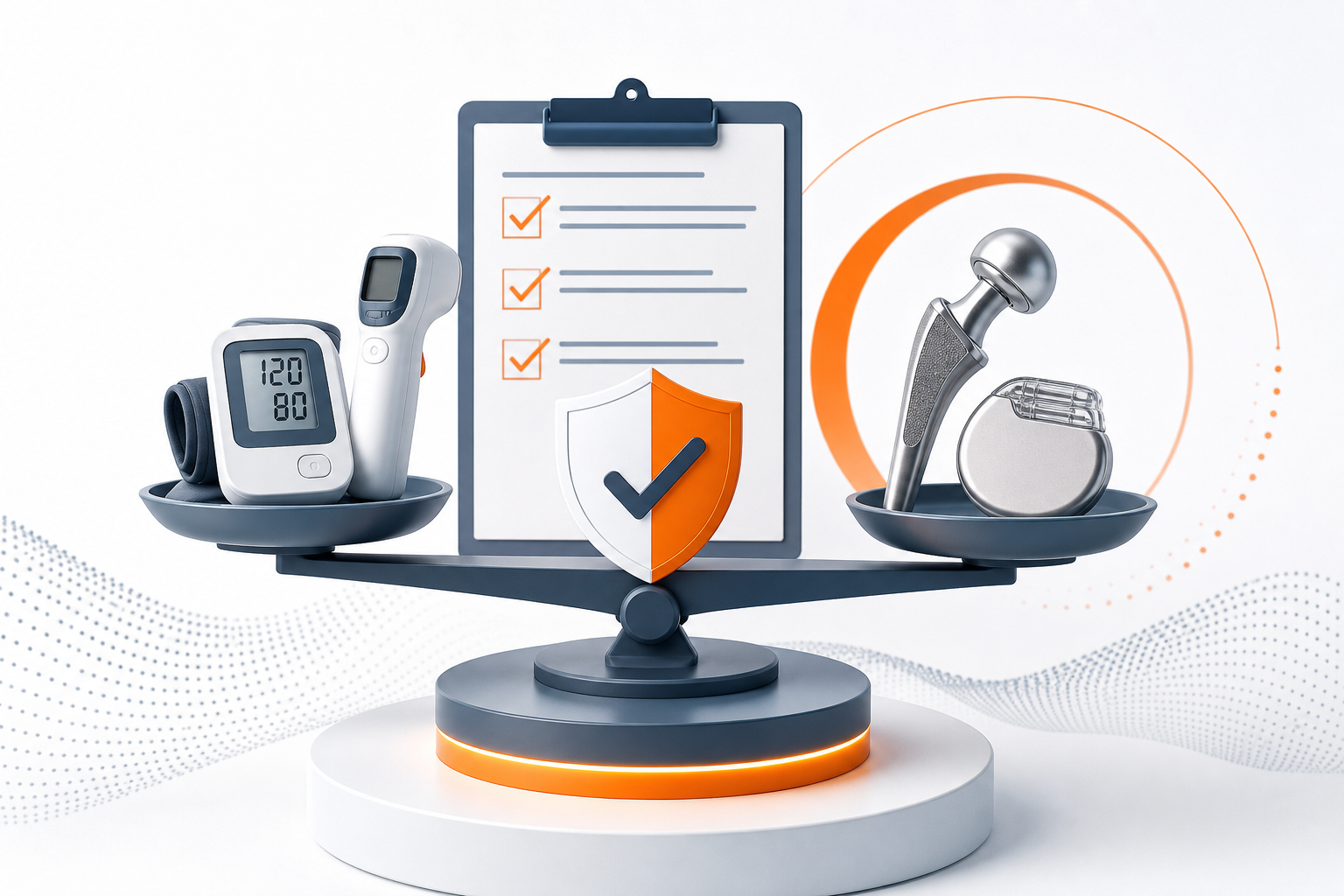
Medical device classification sits at the center of every regulatory strategy, and class II is where most sponsors land — and where the rules carry the most nuance. Class II covers an unusually wide range of device types, from blood pressure monitors to orthopedic implants, and the regulatory requirements attached to that classification shape your entire path to market and, critically, your clinical evidence strategy.
This article breaks down what class II means under FDA rules, how the 510(k) pathway works, where clinical data becomes necessary, and what sponsors need to understand before committing to a trial strategy.
What Makes a Device Class II
FDA classifies medical devices into three classes based on the level of control needed to provide reasonable assurance of safety and effectiveness. Class I carries the lowest risk. Class III carries the highest. Class II sits in the middle — and that middle ground is where the regulatory complexity lives.
A class II device is one for which general controls alone (labeling, manufacturing standards, registration) are insufficient to provide that assurance, but for which enough existing scientific and clinical knowledge exists to establish special controls. Special controls include performance standards, post-market surveillance requirements, guidance documents, and clinical data requirements that vary by device type.
FDA assigns every device a product code and a regulation number under 21 CFR Parts 862 through 892. That regulation number tells you the device type, the classification, and the applicable special controls. If your device doesn't have a predicate in an existing product code, you may need to petition FDA to create one — a process that adds time and cost before you've submitted anything.
The 510(k) Pathway: Core Mechanics
Most class II devices reach the US market through a 510(k) premarket notification. The 510(k) is not an approval — it is a clearance. You are not proving your device is safe and effective in absolute terms. You are demonstrating substantial equivalence to a legally marketed predicate device.
Substantial equivalence requires showing that your device has the same intended use as the predicate and either the same technological characteristics, or different technological characteristics that don't raise new questions of safety and effectiveness and perform at least as well as the predicate.
Three types of 510(k) submissions exist:
- Traditional 510(k): The standard route. Full summary of safety and effectiveness data, comparison to predicate, and supporting bench, animal, and clinical data where required.
- Abbreviated 510(k): Used when FDA has issued a special controls guidance document for the device type. You demonstrate compliance with that guidance rather than building a full predicate comparison from scratch.
- Special 510(k): Used for modifications to your own legally cleared device. Relies on design controls and risk analysis to demonstrate the modification doesn't affect safety or effectiveness.
FDA's target review time for a standard 510(k) is 90 days. In practice, the clock stops whenever FDA issues an Additional Information (AI) request — which means real-world timelines frequently extend to 6 to 12 months or longer, depending on submission complexity and the number of AI cycles.
When Clinical Data Is Required for Class II
This is the question most sponsors underestimate. The assumption that class II devices don't need clinical data is wrong. Whether clinical data is required depends on the device type, the predicate, the technological differences, and the special controls applicable to your product code.
FDA's guidance on 510(k) content makes clear that clinical data may be needed when bench and animal testing can't adequately characterize performance in the intended use environment, when the device interacts with the human body in ways that require in vivo evidence, or when the special controls for your device type specifically call for clinical performance data.
For implantable class II devices, active devices with direct patient contact, or devices where the predicate comparison involves performance claims that can only be validated clinically, a clinical study is not optional. It is a submission requirement.
This is where the clinical strategy decision becomes consequential. If your 510(k) will require a clinical dataset, you face the same planning questions as any sponsor preparing for a first-in-human study: where to run the study, how long it will take, what the per-patient cost looks like, and whether the resulting data will satisfy FDA's review criteria.
Class II vs. Class III: Where the Line Falls
Understanding what separates class II from class III matters because some devices start as class III candidates and work toward reclassification, while others are developed with the intent to pursue a De Novo pathway to establish a new class II category.
Class III devices require Premarket Approval (PMA) — the most demanding regulatory pathway FDA operates. PMA requires valid scientific evidence, typically from well-controlled clinical investigations, demonstrating reasonable assurance of safety and effectiveness. The evidentiary bar is substantially higher than 510(k), and the timeline is correspondingly longer.
A device that lacks a predicate and doesn't fit neatly into an existing class I or class II product code is automatically class III by default. The De Novo pathway allows sponsors to petition FDA to reclassify such a device into class I or class II by establishing new special controls. A successful De Novo creates a new product code, and the approved device then becomes a predicate that other sponsors can reference.
For sponsors at the pre-clinical or IDE-ready stage, knowing whether your device is genuinely class II eligible — or whether it will require De Novo or PMA — determines the entire regulatory timeline and capital requirement.
Special Controls and What They Actually Require
Special controls are the mechanism FDA uses to manage class II risk. They are not uniform. Each product code carries its own set, and those controls define the evidence you need to generate.
Common special controls include:
- Performance testing standards (mechanical, electrical, biocompatibility per ISO 10993)
- Software validation requirements under 21 CFR 820 and FDA's Software as a Medical Device (SaMD) guidance
- Labeling requirements specifying contraindications, warnings, and instructions for use
- Post-market surveillance obligations under 21 CFR 822
- Clinical performance data requirements specifying study design, endpoints, and patient population
When a device's special controls include clinical performance data, the study design must satisfy those requirements precisely. An underpowered study, a poorly defined primary endpoint, or a patient population that doesn't match the intended use will generate an AI request — or a Not Substantially Equivalent (NSE) determination.
Getting the study design right before you start enrolling patients is not a detail. It is the foundational work that determines whether your clinical investment produces a usable 510(k) dataset.
The IDE Question for Class II Studies
If your class II device requires a clinical study and poses more than minimal risk, you may need an Investigational Device Exemption (IDE) before that study can begin in the United States. Under 21 CFR Part 812, a significant risk (SR) device study requires an approved IDE from FDA before enrollment begins.
Non-significant risk (NSR) studies don't require a formal IDE application to FDA, but they do require Institutional Review Board (IRB) approval and must comply with abbreviated IDE requirements.
The SR/NSR determination is made by the IRB in the first instance, but FDA's guidance makes clear that sponsors should conduct their own SR/NSR assessment and be prepared to defend it. Getting this wrong — treating an SR device as NSR — creates compliance exposure that can invalidate the data.
For sponsors who want to generate clinical evidence before committing to a US IDE, running a first-in-human study outside the United States is a legitimate and well-established strategy. Foreign clinical data is accepted for US IDE and IND submissions under FDA 21 CFR 812.28, provided the data is collected under conditions comparable to US standards and the study design meets FDA's requirements. Acceptance is not automatic — it depends on study design and data quality.
Class II Clinical Strategy: The LATAM Acceleration Option
For class II device sponsors who need clinical evidence to support a 510(k) or build toward an IDE, running that study in Latin America offers a materially different cost and timeline profile than the US or EU.
Ethics and regulatory approvals in Panama, El Salvador, Chile, and the Dominican Republic are observed in 30 to 90 days — compared to 6 to 12 months in the US or EU. Per-patient costs in Panama range from $12,000 to $22,000. For a sponsor working within a $1 million to $5 million clinical budget with an investor milestone tied to a specific date, those numbers change what is achievable within a single funding cycle.
The Cook Group's multi-site first-in-human study of an artificial venous valve, run across Colombia with more than 142 INVIMA regulatory submissions managed, is one example of how complex class II-adjacent device programs have been executed in the region with full regulatory rigor. The Cook Group case study on the bioaccess® site details the operational and regulatory mechanics of that program.
Envveno Medical's path to the first-ever FDA IDE for a non-surgical replacement venous valve illustrates how a LATAM first-in-human foundation translates directly into a US regulatory submission — exactly the bridge that class II sponsors with clinical data requirements need to understand.
The key requirement is that the study is designed to FDA standards from the start. Data collected under ISO 14155 protocol architecture and structured per FDA 21 CFR 812.28 can support a US submission. Data collected without that design discipline cannot.
510(k) Submission: What FDA Reviews
A complete 510(k) submission includes a defined set of elements. Understanding what FDA reviewers look for helps sponsors build the right evidence package from the beginning rather than retrofitting data after an AI request.
FDA reviews:
- Device description: Intended use, indications for use, technological characteristics
- Predicate comparison: Substantial equivalence argument with side-by-side feature comparison
- Performance testing summary: Bench, animal, and clinical data supporting safety and effectiveness claims
- Biocompatibility: ISO 10993 testing appropriate to the device's nature of contact and duration
- Software documentation: If applicable, per FDA's Software as a Medical Device guidance
- Labeling: Draft labeling consistent with the intended use and special controls
- Sterilization and shelf life: If applicable
- Clinical data: When required by special controls or the nature of the predicate comparison
The most common reasons for AI requests are incomplete performance testing, inadequate predicate comparison, missing or insufficient clinical data, and labeling that doesn't match the intended use. Each AI cycle adds months to the review clock.
De Novo: Creating a New Class II Category
When a novel device lacks a predicate and the sponsor believes class II controls are sufficient to manage the risk, the De Novo pathway is the route to market. A successful De Novo results in a new product code, a classification order, and a legally marketed device that other sponsors can use as a predicate.
The De Novo process requires demonstrating that general controls and special controls together provide reasonable assurance of safety and effectiveness. FDA reviews the proposed special controls as part of that process. For genuinely novel devices, the evidentiary requirements sit closer to PMA than to a standard 510(k).
De Novo timelines are longer than 510(k) — FDA's target is 150 days, but complex submissions take longer. Sponsors pursuing De Novo need to plan for a clinical evidence package that supports the proposed special controls, which often means a well-designed first-in-human or early feasibility study.
The ClarVista Medical case study — a LATAM first-in-human program that ultimately led to an Alcon acquisition — illustrates how early-stage clinical execution in Latin America can support the kind of evidence package that moves a novel ophthalmic device through the US regulatory process.
Post-Market Requirements for Class II Devices
Clearance is not the end of the regulatory relationship with FDA. Class II devices carry post-market obligations that sponsors need to plan for before they reach market.
Medical Device Reporting (MDR) under 21 CFR Part 803 requires manufacturers to report device malfunctions, serious injuries, and deaths to FDA. Reporting timelines are strict: 30 days for most events, 5 days for events requiring remedial action to prevent unreasonable risk.
Post-market surveillance under 21 CFR Part 822 may be ordered by FDA for class II devices when the agency determines that post-market data is needed to protect public health. This is more common for implantable devices and devices with novel technologies.
Quality System Regulation (QSR) under 21 CFR Part 820 — now transitioning to alignment with ISO 13485 — applies to all class II manufacturers. Design controls, corrective and preventive action (CAPA), complaint handling, and production and process controls are all auditable.
Sponsors who treat regulatory compliance as a pre-market activity only will encounter problems. Building quality system infrastructure in parallel with clinical development is the standard FDA expects.
Preparing for a Pre-Sub Meeting
Before committing to a 510(k) strategy, most class II sponsors benefit from a Pre-Submission (Pre-Sub) meeting with FDA. A Pre-Sub is a formal mechanism to get FDA's feedback on your regulatory approach, your proposed predicate, your study design, and your performance testing plan before you invest in generating the data.
FDA responds to Pre-Sub requests in writing within 90 days. The response is not binding, but it provides a documented basis for your development decisions. If FDA identifies a problem with your predicate selection or proposed clinical study design in a Pre-Sub response, you can address it before spending the budget — not after.
For sponsors considering a LATAM clinical study to generate 510(k) or IDE-supporting data, the Pre-Sub is the right place to confirm that FDA will accept foreign clinical data for your specific submission and to agree on study design requirements in advance.
Practical Checklist for Class II Sponsors
Before finalizing your regulatory strategy, confirm the following:
- Your device's product code and regulation number under 21 CFR Parts 862–892
- The applicable special controls for your product code and whether they require clinical data
- Whether a predicate device exists and whether it supports a substantial equivalence argument
- Whether your study, if required, qualifies as SR or NSR under IDE rules
- Whether a Pre-Sub meeting would de-risk your predicate or study design decisions
- Whether your clinical budget and timeline are compatible with a US-based study or whether a LATAM execution strategy better fits your financial runway
For device types where LATAM execution is appropriate, the Hasten/Ampcare case study demonstrates how the COFEPRIS-04-050 abbreviated pathway in Mexico was used to register a TENS device — a practical example of how Latin American regulatory infrastructure can serve device sponsors at different stages of their commercial strategy.
Frequently Asked Questions
What is a class II medical device under FDA rules?
A class II medical device is one for which general controls alone are insufficient to provide reasonable assurance of safety and effectiveness, but for which special controls — such as performance standards, post-market surveillance, and clinical data requirements — can provide that assurance. Most class II devices reach the US market through a 510(k) premarket notification demonstrating substantial equivalence to a legally marketed predicate.
Does a class II device always need clinical data for a 510(k)?
Not always, but more often than sponsors expect. Whether clinical data is required depends on the device type, the applicable special controls, and the nature of the predicate comparison. Implantable devices, active devices with direct patient contact, and devices where performance claims can only be validated in vivo typically require clinical data as part of the 510(k) submission.
What is the difference between a 510(k) and a De Novo for class II?
A 510(k) relies on substantial equivalence to an existing predicate device. A De Novo is used when a novel device lacks a predicate and the sponsor wants to establish a new class II product code. A successful De Novo creates a new predicate that other sponsors can reference. De Novo requires more evidence than a standard 510(k) and takes longer to review.
Can clinical data from Latin America support a US 510(k) or IDE submission?
Yes. Under FDA 21 CFR 812.28, foreign clinical data is accepted for US IDE and IND submissions when collected under conditions comparable to US standards. The study must be designed to FDA requirements from the start — including ISO 14155 protocol architecture and appropriate GCP compliance. FDA acceptance depends on study design and data quality and is not automatic.
When does a class II study require an IDE?
A clinical study involving a class II device that poses significant risk requires an approved IDE from FDA before enrollment begins in the United States. Non-significant risk studies require IRB approval and compliance with abbreviated IDE requirements but do not require a formal FDA IDE application. The SR/NSR determination should be made carefully — misclassifying an SR device as NSR creates compliance exposure.
What are special controls and why do they matter for class II sponsors?
Special controls are device-type-specific requirements FDA uses to manage class II risk. They vary by product code and can include performance testing standards, biocompatibility requirements, software validation, labeling requirements, post-market surveillance obligations, and clinical data requirements. Understanding the special controls for your specific product code is essential before you design your evidence generation strategy.
How long does a 510(k) review take?
FDA's target review time for a standard 510(k) is 90 days, but the clock stops during any Additional Information request period. In practice, complex submissions with clinical data requirements or multiple AI cycles frequently take 6 to 12 months from submission to clearance. A Pre-Sub meeting before submission can reduce AI cycles by resolving predicate and study design questions in advance.
Build the Right Evidence Package from the Start
Class II regulation is not a single rule — it is a framework that varies significantly by device type, predicate, and the specific special controls attached to your product code. The sponsors who move through the 510(k) process efficiently are the ones who understand those specifics before they start generating data, not after.
If your class II device requires clinical evidence and your timeline can't absorb a 12-to-18-month US study startup, understanding your LATAM options is a practical next step. bioaccess® works with device sponsors at the pre-clinical to IDE-ready stage to design and execute first-in-human and early feasibility studies structured for FDA submission. Learn more at bioaccessla.com.
Leave a Reply