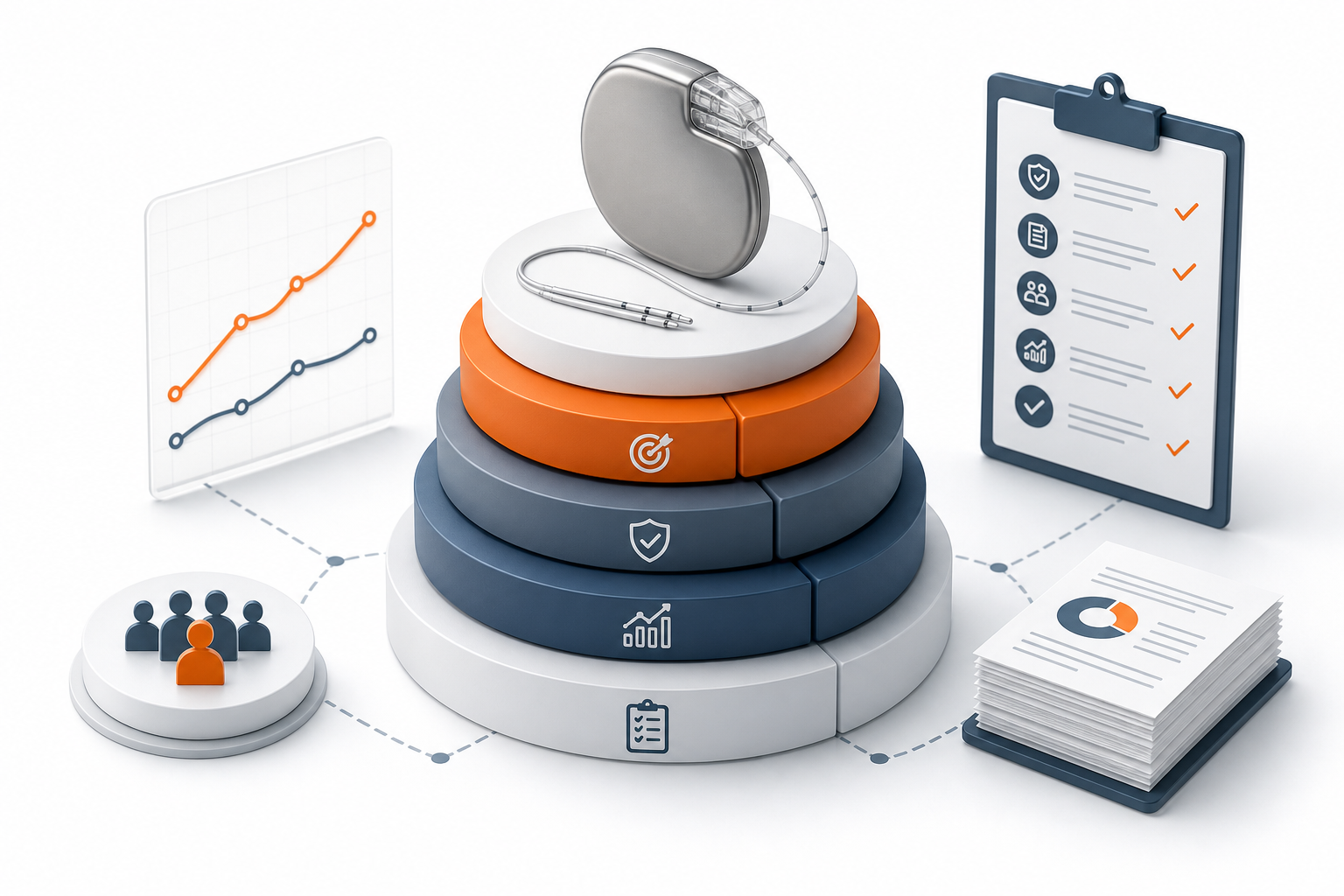
- What Makes a PMA Different From Other Approval Pathways
- The Core Components of a PMA Clinical Evidence Package
- Where Sponsors Build Weak Evidence Packages
- How Trial Location Affects Your Evidence Package
- Building the Evidence Package With a Single Accountable Team
- The Pre-PMA Submission Checklist
- What the FDA Reviews in the Clinical Section
- FAQs: PMA Clinical Trial Requirements
- Build the Evidence Package Before You Need It
A PMA clinical trial is one of the most demanding regulatory milestones a medical device company will face. Unlike the 510(k) pathway, which relies on substantial equivalence to a predicate, Premarket Approval requires you to generate original clinical evidence demonstrating that your device is safe and effective for its intended use. The FDA will not approve a Class III device on bench data and animal studies alone. You need a clinical evidence package, and it needs to be built correctly from the start.
This article covers what the FDA expects, how to structure that package, where most sponsors go wrong, and how your trial execution strategy affects the quality and timing of the data you ultimately submit.
What Makes a PMA Different From Other Approval Pathways
The PMA pathway applies to Class III devices: those that support or sustain human life, present a potential unreasonable risk of illness or injury, or lack a substantially equivalent predicate. Implantable cardiac devices, neurostimulators, and certain diagnostic systems are common examples.
Because no predicate exists, the FDA requires sponsors to prove safety and effectiveness through valid scientific evidence. That standard is defined in 21 CFR Part 860 and typically means well-controlled clinical investigations producing statistically valid results.
The 510(k) pathway can sometimes be cleared with retrospective data or literature reviews. The PMA pathway almost never can. You are building a prospective clinical record from scratch.
The Core Components of a PMA Clinical Evidence Package
The FDA expects the clinical section of a PMA submission to contain several interconnected elements. Missing or underpowered components are the most common trigger for Additional Information (AI) requests and major deficiencies.
Investigational Device Exemption (IDE) Approval
Before enrolling a single patient in a significant-risk device study, you need an approved IDE under 21 CFR Part 812. The IDE authorizes use of your device in human subjects during the investigation phase. For significant-risk devices, it is not optional.
Your IDE application must include the investigational plan (protocol), a risk analysis, device description, informed consent procedures, IRB approvals, and a monitoring plan. The FDA has 30 days to respond. If they do not disapprove it within that window, you may proceed.
The IDE is the foundation of your clinical evidence package. A weak protocol produces weak data. What you write at this stage directly determines whether the evidence you collect will hold up in the PMA submission.
Clinical Protocol and Study Design
The protocol is where most sponsors either set themselves up for success or create problems they will spend years correcting. The FDA expects a study design that:
- Defines a primary endpoint that maps directly to the device's intended use
- Specifies a statistically justified sample size with power calculations
- Identifies a control arm or objective performance criteria (OPC) where applicable
- Describes follow-up duration sufficient to capture the safety and effectiveness signals relevant to the indication
- Pre-specifies analysis populations (intent-to-treat, per-protocol) and statistical methods
Adaptive designs are increasingly accepted, but they require pre-specification of adaptation rules and FDA agreement before the trial begins. Do not adapt your protocol mid-study without prior FDA concurrence.
Pre-Submission (Q-Sub) Meetings
Before finalizing your protocol, request a Pre-Submission (Pre-Sub) meeting with the FDA under the Q-Submission program. This is one of the highest-leverage steps available to any PMA sponsor. A Pre-Sub gives you written FDA feedback on your proposed study design, endpoints, and statistical analysis plan before you commit to executing the trial.
Sponsors who skip the Pre-Sub and design protocols in isolation frequently discover at the PMA review stage that the FDA had different expectations about endpoint definitions, follow-up duration, or the adequacy of the control. That discovery, made after data collection is complete, is expensive and sometimes fatal to the program.
Use the Pre-Sub to confirm your primary endpoint, discuss the acceptability of your control strategy, and align on what "valid scientific evidence" means for your specific device and indication.
Statistical Analysis Plan (SAP)
The SAP must be finalized and locked before unblinding or completing enrollment. It specifies every analysis the FDA will review: primary and secondary endpoint analyses, subgroup analyses, handling of missing data, multiplicity adjustments, and interim analysis rules if applicable.
A SAP written after the fact, or one that does not match the protocol, is a major deficiency. The FDA's reviewers are statisticians. They will compare your SAP to your protocol and to your actual analysis. Discrepancies get flagged.
Clinical Study Report (CSR)
The CSR is the formal document presenting all clinical findings from your investigation. It follows ICH E3 structure and must include:
- Full protocol and amendments
- Patient disposition and demographics
- Primary and secondary endpoint results with confidence intervals
- Adverse event and serious adverse event summaries
- Subgroup analyses
- Individual patient data listings
The CSR is not a summary. It is a complete, auditable record of what happened in the trial. The FDA reviewer will read it alongside your raw data. Inconsistencies between the narrative and the data tables are a recurring source of deficiencies.
Device History and Bench Data
The clinical section does not stand alone. The FDA reviews it alongside your device description, bench testing, biocompatibility data (ISO 10993), sterilization validation, and software documentation where applicable. The clinical evidence package must be internally consistent with the device you tested. If your final design changed after IDE approval, document those changes and assess whether they affect the clinical data's applicability.
Where Sponsors Build Weak Evidence Packages
Several patterns consistently produce deficient PMA submissions.
Underpowered studies. Sample size calculations that assume unrealistically high effect sizes or low event rates result in studies that cannot demonstrate effectiveness even when the device performs well. The FDA will not accept a study that was never capable of answering the question it was designed to answer.
Endpoint drift. Changing the primary endpoint after data collection begins, even informally, is a serious problem. If your final CSR analyzes a different primary endpoint than the one in your IDE-approved protocol, the FDA will treat the original endpoint as primary and the new one as exploratory. Plan your endpoints carefully and hold to them.
Inadequate follow-up. For implantable or long-term-use devices, the FDA often expects data at 12, 24, or 36 months. Sponsors who design studies with six-month follow-up to save time frequently receive AI requests requiring additional data collection, extending the overall timeline by more than the time they tried to save.
Site qualification gaps. Sites that are not properly qualified, trained, or monitored produce data with integrity questions. The FDA can and does inspect clinical sites during PMA review. Data from sites with significant protocol deviations or monitoring deficiencies may be excluded from the analysis.
Missing or incomplete informed consent documentation. Every enrolled patient must have a properly documented informed consent process. Missing consent forms, or forms that do not reflect the approved protocol version, are a recurring finding in FDA inspections.
How Trial Location Affects Your Evidence Package
Where you run your PMA clinical trial has a direct effect on how quickly you can generate data and what it costs to generate it. These are not trivial considerations when your runway is finite and your board is watching the milestone calendar.
US-based trials for significant-risk devices face IRB review timelines of three to six months per site, site activation timelines that often stretch beyond a year for complex devices, and per-patient costs that can run well above $30,000 depending on the indication and site infrastructure.
Latin American markets operate differently. In Panama, El Salvador, Chile, and the Dominican Republic, ethics and regulatory approvals are consistently observed in 30 to 90 days. That reflects actual observed performance across those markets, not a contractual guarantee from the health authorities. Patient populations in these countries are often treatment-naive for novel devices, which can improve enrollment rates and reduce the confounding effect of prior interventions on your primary endpoint.
The critical question for PMA purposes is whether data collected outside the US will be accepted by the FDA. The answer is yes, when the data is collected under an IDE and structured in accordance with 21 CFR 812.28, which governs the acceptance of foreign clinical study data. The study must be conducted under conditions comparable to US standards, using ICH-GCP-compliant protocols and ISO 14155 trial architecture. When those conditions are met, foreign clinical data supports both IDE and PMA submissions.
This is not a workaround. It is an established FDA framework that sponsors have used to accelerate timelines without compromising the quality of the evidence package.
Building the Evidence Package With a Single Accountable Team
The most common operational failure in PMA clinical programs is fragmentation. Sponsors use one vendor for regulatory strategy, a second for protocol development, a third for site management, and a fourth for data management. When the FDA asks a question about the relationship between a protocol amendment and a data collection change, no single person can answer it. The evidence package reflects the seams between vendors.
A structured approach that covers all workstreams under one accountable team produces a more coherent evidence package and a faster path through FDA review. Every component, from the Pre-Sub meeting through the final CSR, needs to be built by people who understand how each piece connects to the next.
bioaccess® operates the FIH-12 program on exactly this model: nine workstreams managed by a single team, from FDA Pre-Sub and IDE/IND pathway alignment through protocol development, site activation, patient enrollment, data management, and delivery of a submission-ready clinical evidence package within a 12-month timeline. Trial execution runs across 19 Latin American and Caribbean markets through a network of 50-plus pre-qualified sites, with the final deliverable structured for the sponsor's next FDA regulatory step.
For PMA programs, that means the CSR and organized data room arrive ready for submission, not requiring reconstruction by a regulatory affairs team that was not present during the trial.
The Pre-PMA Submission Checklist
Before submitting your PMA, the clinical section should contain the following:
- Approved IDE and all amendments
- Final protocol with all versions documented
- Locked statistical analysis plan
- IRB approvals for all sites
- Informed consent forms for all enrolled patients
- Clinical study report following ICH E3 structure
- Adverse event narratives for all serious adverse events
- Individual patient data listings
- Site monitoring reports and audit trails
- Investigator qualifications and CVs
- Device accountability records
If any of these elements is missing or incomplete at submission, expect an AI request. AI requests add months to your review timeline. Getting the evidence package right before submission is faster than correcting it afterward.
What the FDA Reviews in the Clinical Section
The FDA's review of the clinical section focuses on several core questions:
- Was the study designed to answer the right question for the intended use?
- Was it conducted in accordance with the approved protocol and applicable regulations?
- Does the primary endpoint analysis demonstrate a reasonable assurance of safety and effectiveness?
- Are the adverse event data complete and accurately reported?
- Do the benefits outweigh the risks for the intended patient population?
Reviewers are not looking for perfection. They are looking for scientific rigor, regulatory compliance, and honest reporting. A well-designed study showing modest benefit with a clear safety profile is more likely to succeed than an ambitious study with data integrity problems.
FAQs: PMA Clinical Trial Requirements
What is a PMA clinical trial and when is it required?
A PMA clinical trial is a clinical investigation conducted to generate the safety and effectiveness data required for FDA approval of a Class III medical device. It is required when a device cannot be cleared through the 510(k) pathway because no substantially equivalent predicate exists, or when the device presents a high risk to patients.
Do I need an IDE before starting a PMA clinical trial?
Yes. For significant-risk devices, an approved Investigational Device Exemption (IDE) under 21 CFR Part 812 is required before enrolling patients. The IDE application includes your protocol, risk analysis, device description, and IRB approvals. The FDA has 30 days to respond before you may proceed.
Can I use clinical data collected outside the United States in a PMA submission?
Yes. Foreign clinical data is accepted in PMA submissions when collected under an IDE and structured in accordance with 21 CFR 812.28. The study must be conducted under ICH-GCP-compliant conditions and meet the applicable FDA standards for the evidence type.
What is a Pre-Submission meeting and why does it matter for PMA programs?
A Pre-Submission (Pre-Sub or Q-Sub) meeting is a formal FDA feedback mechanism that allows sponsors to get written agency input on study design, endpoints, and statistical approaches before committing to a trial. For PMA programs, it is one of the most important steps you can take to reduce the risk of a major deficiency at the review stage.
How long does a PMA clinical trial typically take?
Timeline depends on the indication, study design, enrollment rate, and follow-up requirements. US-based trials for significant-risk devices commonly take 18 to 36 months from IDE approval to CSR completion. Trials executed in Latin American markets with faster regulatory approval timelines can compress the pre-enrollment phase significantly, though follow-up duration is determined by the protocol, not the geography.
What is the most common reason for a PMA clinical deficiency?
Underpowered study designs, endpoint drift, inadequate follow-up, and site data integrity issues are the most frequent sources of major deficiencies. Endpoint drift is the most preventable, and it is eliminated by finalizing your endpoints during the Pre-Sub process and locking your SAP before data collection begins.
How should the clinical study report be structured for a PMA submission?
The CSR should follow ICH E3 structure and include the full protocol and amendments, patient disposition, primary and secondary endpoint results with confidence intervals, adverse event summaries, subgroup analyses, and individual patient data listings. It must be internally consistent with the data tables and the approved protocol. Inconsistencies between the narrative and the data are a common source of AI requests.
Build the Evidence Package Before You Need It
The clinical evidence package for a PMA submission is not something you assemble at the end of a trial. It is built incrementally, starting with the Pre-Sub meeting and ending with a locked CSR and organized data room. Every decision made during protocol development, site selection, and data management either strengthens or weakens the package you will eventually hand to the FDA.
Sponsors who treat the evidence package as a documentation exercise discover its importance during review. Sponsors who treat it as the product of the trial build programs that move through FDA review with fewer deficiencies and shorter timelines.
If you are planning a PMA clinical trial and want to understand how trial execution in Latin America fits into your FDA evidence strategy, bioaccess® works with MedTech sponsors at exactly this stage of program planning.
WordPress category: Navigating Regulatory Landscapes in Latin America
Leave a Reply