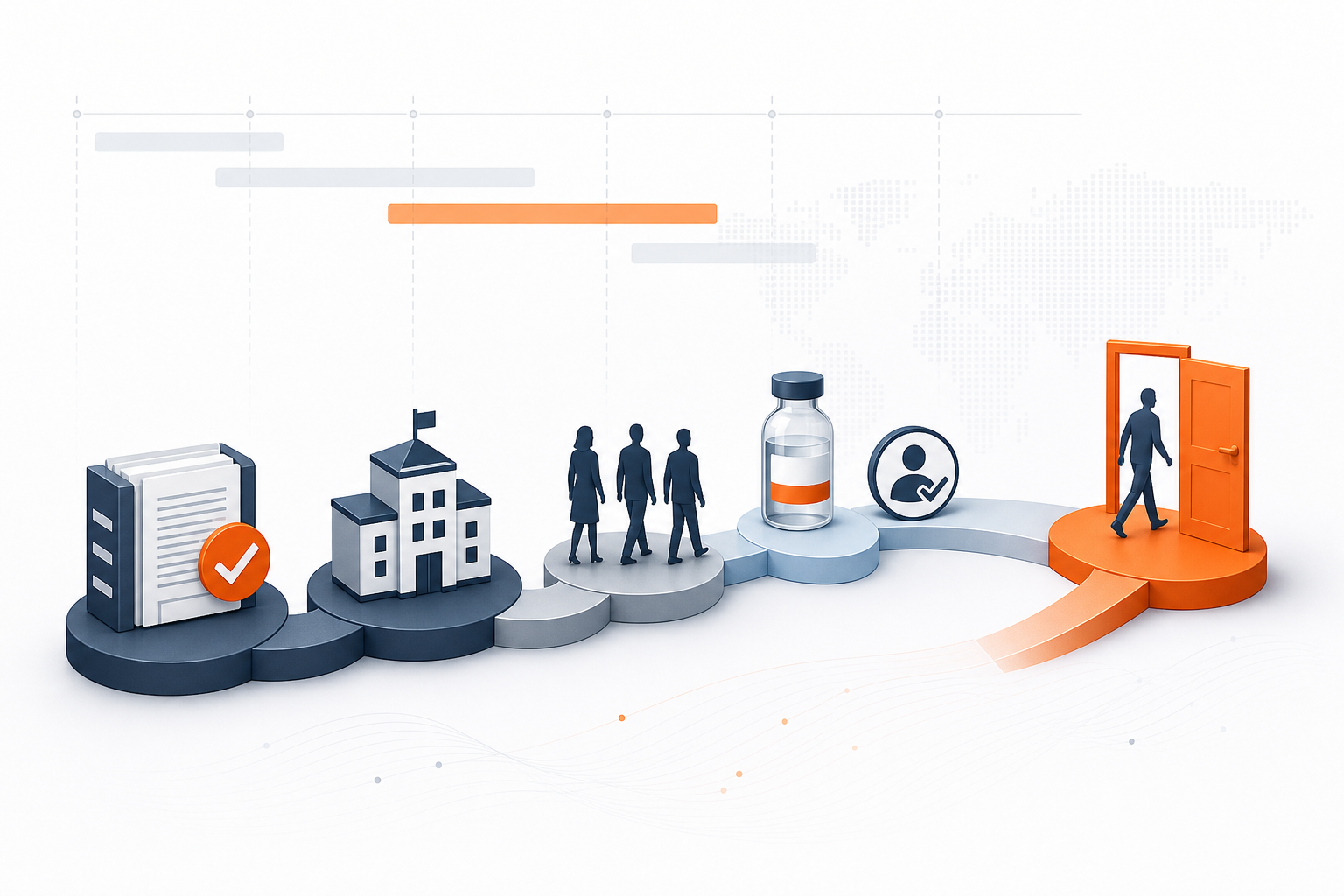
- What "Protocol Approval" Actually Means as a Starting Point
- Phase 1: Regulatory and Ethics Approvals
- Phase 2: Site Activation
- Phase 3: Patient Enrollment
- Phase 4: Treatment and Follow-Up
- Phase 5: Data Lock and Submission-Ready Package
- What a Realistic End-to-End Timeline Looks Like
- Where Startups Lose Time — and How to Avoid It
- How the FIH-12 Program Structures the Timeline
- FAQs
- Plan the Timeline Before the Board Asks
A first-in-human (FIH) trial is one of the most consequential milestones in any medical device or biopharma program — and one of the most consistently misread from a timing standpoint. Founders anchor investor timelines to a vague "18 to 24 months," then discover mid-program that the approval queue alone consumed most of that window before a single patient was screened.
This article maps the actual phases of a first-in-human trial timeline, from protocol approval through last patient out (LPO). It covers where time is lost, where it can be recovered, and which structural decisions made early determine whether your FIH data lands before or after your next funding round.
What “Protocol Approval” Actually Means as a Starting Point
The phrase sounds like a single event. In practice, it represents the convergence of several parallel workstreams: a finalized protocol document, an approved IDE or IND application, ethics committee clearance, and written authorization from the relevant in-country health authority.
Each of those has its own queue. In the United States, IDE review alone typically takes three to six months after submission. Ethics review at U.S. sites often adds another two to four months — and sites may not run those processes concurrently. By the time you have a protocol approved and a site ready to screen patients, you may already be nine to twelve months into your clock.
This is why jurisdiction selection is not a logistical detail. It is a timeline decision.
Phase 1: Regulatory and Ethics Approvals
This phase begins the moment your submission package is filed with the relevant health authority and ethics committee. It ends when you have written authorization to proceed at a qualified site.
In the United States or European Union, this phase routinely takes six to twelve months. Review queues are long, and novel device classes often generate multiple rounds of questions and amendments before authorization is granted.
In Panama, El Salvador, Chile, and the Dominican Republic, ethics and regulatory approvals are observed in 30 to 90 days. That is not a marketing claim — it reflects the structural design of those jurisdictions' review frameworks. MINSA/CNBI in Panama, SRS/CNEIS in El Salvador, ISP/MINSAL in Chile, and the Dominican Republic's equivalent health authority all operate under processes that are faster by design, not by exception.
Recovering four to nine months at this phase alone changes the math for a startup operating on a 24-month runway.
Phase 2: Site Activation
Site activation covers everything between regulatory authorization and the first patient screened: finalizing site agreements, training investigators and coordinators, confirming equipment and logistics, and standing up your electronic data capture (EDC) system at the site.
At a well-prepared site with an experienced coordinator team, this phase takes four to eight weeks. At a site that has never run a device trial under ISO 14155 or FDA 21 CFR 812.28 standards, it can stretch to three to four months.
This is where a pre-qualified site network pays a measurable dividend. Sites that have already been verified for infrastructure, staffing, and regulatory familiarity compress activation to the shorter end of that range. bioaccess® maintains a network of 50-plus pre-qualified sites across 19 Latin American and Caribbean markets — which means you are not rebuilding site readiness from scratch every time you open a new location.
Site activation also includes the practical work of setting up patient identification and screening pipelines. Enrollment projections made without a realistic assessment of site-level recruitment capacity are one of the most common sources of timeline slippage.
Phase 3: Patient Enrollment
Enrollment is where most FIH timelines diverge from plan. The variables are well known — inclusion/exclusion criteria, site-level patient flow, competing trials, screen failure rates — but they are still routinely underestimated.
For a small FIH cohort of 10 to 30 patients, enrollment at a single site in a high-competition U.S. market can take six to twelve months. In Latin American markets with lower trial density and strong investigator engagement, the same cohort often enrolls in two to four months.
A few factors that materially affect enrollment speed:
- Indication prevalence at the site. A cardiovascular device trial at a high-volume cardiac center in Panama or Colombia will screen faster than the same trial at a community hospital with limited patient throughput.
- Screen failure rate. For novel device classes with narrow eligibility criteria, screen failure rates of 40 to 60 percent are common. Building that into your enrollment model upfront prevents mid-trial surprises.
- Regulatory flexibility on amendments. If your protocol requires a mid-enrollment amendment — a common occurrence in early feasibility studies — the time to get that amendment approved varies significantly by jurisdiction.
Phase 4: Treatment and Follow-Up
For most FIH device studies, the treatment period itself is relatively short — days to weeks per patient. The follow-up period is where the timeline stretches. Depending on device class and endpoint structure, follow-up windows of 30 days, 90 days, six months, or longer are common.
Last patient out is defined as the date the final enrolled patient completes their last protocol-required visit. Everything before that point — enrollment, treatment, interim assessments — determines when LPO actually occurs.
The relationship between enrollment pace and LPO is direct. Enroll your last patient at month eight of a study with a 90-day follow-up, and LPO lands at month eleven. Let enrollment drag to month twelve, and LPO moves to month fifteen. This is why front-end enrollment compression has compounding value: it pulls LPO forward and accelerates the entire downstream data and submission timeline.
Phase 5: Data Lock and Submission-Ready Package
After LPO, the trial is not over. Data cleaning, query resolution, statistical analysis, and clinical study report (CSR) preparation typically take two to four months for a small FIH study — and six months or more for larger or more complex programs.
This phase is often treated as a formality in early planning conversations, but it is where regulatory acceptability is either confirmed or complicated. Data collected under ICH-GCP and structured per FDA 21 CFR 812.28 — the foreign clinical data framework — is accepted for U.S. IDE and IND submissions. Data collected under looser standards may not be.
That distinction matters specifically for Latin American FIH data. The speed advantage of running a trial in Panama or Chile does not come at the cost of regulatory acceptability, provided the data is collected under the right framework from day one. A submission-ready clinical evidence package built to FDA standards travels with the data regardless of where the patients were enrolled.
What a Realistic End-to-End Timeline Looks Like
Putting the phases together, here is what a realistic FIH timeline from protocol approval to submission-ready package looks like:
| Phase | Optimized (LatAm) | Typical (U.S./EU) |
|---|---|---|
| Regulatory and ethics approvals | 1 to 3 months | 6 to 12 months |
| Site activation | 1 to 2 months | 2 to 4 months |
| Patient enrollment (10 to 30 patients) | 2 to 4 months | 6 to 12 months |
| Treatment and follow-up | 1 to 6 months | 1 to 6 months |
| Data lock and CSR | 2 to 3 months | 3 to 6 months |
| Total | 7 to 18 months | 18 to 40 months |
The treatment and follow-up window is largely fixed by the science, not the geography. Everything else is compressible with the right jurisdiction and site infrastructure.
Where Startups Lose Time — and How to Avoid It
The most damaging sources of FIH timeline slippage are rarely the obvious ones.
Delayed regulatory strategy alignment. Sponsors who select a jurisdiction or site before finalizing their IDE or IND strategy often have to redo submission documents when the regulatory pathway shifts. Anchoring strategy to the intended U.S. pathway — whether IDE, 510(k), De Novo, PMA, or HDE — from day one prevents that rework.
Underestimating the protocol development cycle. A protocol that has not been stress-tested against the target jurisdiction's ethics committee requirements will generate amendment cycles. Each cycle in a slower jurisdiction adds weeks or months to the clock.
Fragmented vendor accountability. Sponsors using separate vendors for regulatory consulting, site selection, CRO operations, and data management often find that no single party owns the end-to-end timeline. Gaps between handoffs accumulate. A single accountable team covering all workstreams from protocol through submission-ready package eliminates those gaps.
Optimistic enrollment projections. Enrollment models built on theoretical site capacity rather than observed recruitment rates at specific sites consistently underperform. Requiring site-level enrollment data before finalizing your timeline is not pessimism — it is planning.
How the FIH-12 Program Structures the Timeline
bioaccess® structures its FIH-12 program around a 12-month timeline from protocol to submission-ready clinical evidence package. The program covers nine workstreams: FDA Pre-Sub and IDE/IND pathway alignment, protocol development, ethics and regulatory submissions, site activation, patient enrollment, clinical monitoring, data management, safety reporting, and CSR preparation.
The 12-month target applies to the FIH-12 program structure; individual timelines depend on device class and regulatory pathway. But the structural design — a single accountable team, pre-qualified sites, and primary execution in jurisdictions where approvals are observed in 30 to 90 days — is what makes that target achievable for most early-feasibility device studies.
The FIH Launch Planner on the bioaccess® site takes six questions and outputs a preliminary country route, timeline range, and evidence package estimate. For sponsors still in the planning phase, it is a useful first step toward a grounded sense of what their specific program might look like before issuing an RFP.
FAQs
What is the typical timeline for a first-in-human trial from protocol approval to last patient out?
For a small FIH cohort of 10 to 30 patients, the enrollment and follow-up phases alone range from approximately four to twelve months. Add regulatory approvals and site activation, and the total range is seven to eighteen months in an optimized Latin American execution versus eighteen to forty months in a typical U.S. or EU program.
Does running a first-in-human trial in Latin America affect FDA acceptance of the data?
No, provided the data is collected under the right framework. Latin American FIH data structured per FDA 21 CFR 812.28 and collected under ICH-GCP and ISO 14155 standards is accepted for U.S. IDE and IND submissions. Geographic origin does not reduce regulatory acceptability when the collection standards are met.
What is "last patient out" and why does it matter for trial planning?
Last patient out (LPO) is the date the final enrolled patient completes their last protocol-required visit. It marks the formal end of data collection and triggers data lock, statistical analysis, and CSR preparation. Because your submission timeline and funding milestones are anchored to it, LPO is one of the most important dates to plan around from the start.
What causes the most timeline slippage in first-in-human trials?
The most common causes are delayed regulatory strategy alignment, optimistic enrollment projections, protocol amendment cycles, and fragmented vendor accountability across workstreams. Each adds weeks or months to the timeline — and they tend to compound each other.
How long does regulatory and ethics approval take for a first-in-human trial?
In the United States or EU, regulatory and ethics approval typically takes six to twelve months. In Panama, El Salvador, Chile, and the Dominican Republic, approvals are observed in 30 to 90 days. This difference is structural to those jurisdictions, not a case-by-case exception.
What is the difference between first patient in and last patient out?
First patient in (FPI) is the date the first enrolled patient receives the investigational treatment or device. Last patient out (LPO) is the date the final enrolled patient completes all protocol-required follow-up visits. The interval between FPI and LPO reflects the combined enrollment duration and follow-up window across the full cohort.
How many patients are typically enrolled in a first-in-human trial?
FIH cohort sizes vary by device class and study design, but early feasibility studies for medical devices commonly enroll between 10 and 30 patients. The cohort is sized to generate initial safety and feasibility data, not to power a definitive efficacy conclusion. The FDA's guidance on early feasibility studies provides the framework for determining appropriate cohort size for a given device category.
Plan the Timeline Before the Board Asks
The most expensive FIH mistake is not a failed enrollment or a regulatory rejection. It is a timeline that was never grounded in how approvals, site activation, and enrollment actually work in the chosen jurisdiction.
If you are 12 to 24 months from needing first human data, the time to map your timeline is now — not when the IDE is approved and the board is asking for a start date. A realistic phase-by-phase plan, built around a jurisdiction where approvals are observed in 30 to 90 days and sites are already qualified, is the difference between delivering FIH data before your next round closes and explaining to investors why it slipped.
Learn more about how bioaccess® structures the FIH timeline at bioaccessla.com.
Leave a Reply