- Why the Nine-Workstream Model Matters
- Workstream 1: FDA Pre-Submission and Regulatory Pathway Alignment
- Workstream 2: Jurisdiction Selection and Regulatory Strategy
- Workstream 3: Protocol Development
- Workstream 4: Ethics and Regulatory Submissions
- Workstream 5: Site Activation
- Workstream 6: Patient Enrollment and Retention
- Workstream 7: Clinical Operations and Safety Monitoring
- Workstream 8: Data Management and Biostatistics
- Workstream 9: Regulatory Submission Package Preparation
- How the Nine Workstreams Fit Together
- FAQs
- Plan Your FIH Program Around the Full Nine Workstreams
A first-in-human clinical trial is one of the most consequential milestones in any medical device or biopharma program. It's the moment your technology moves from bench to body — and every decision made in the months before that first procedure shapes whether your data will hold up to FDA scrutiny, satisfy your board, and carry you to the next funding round.
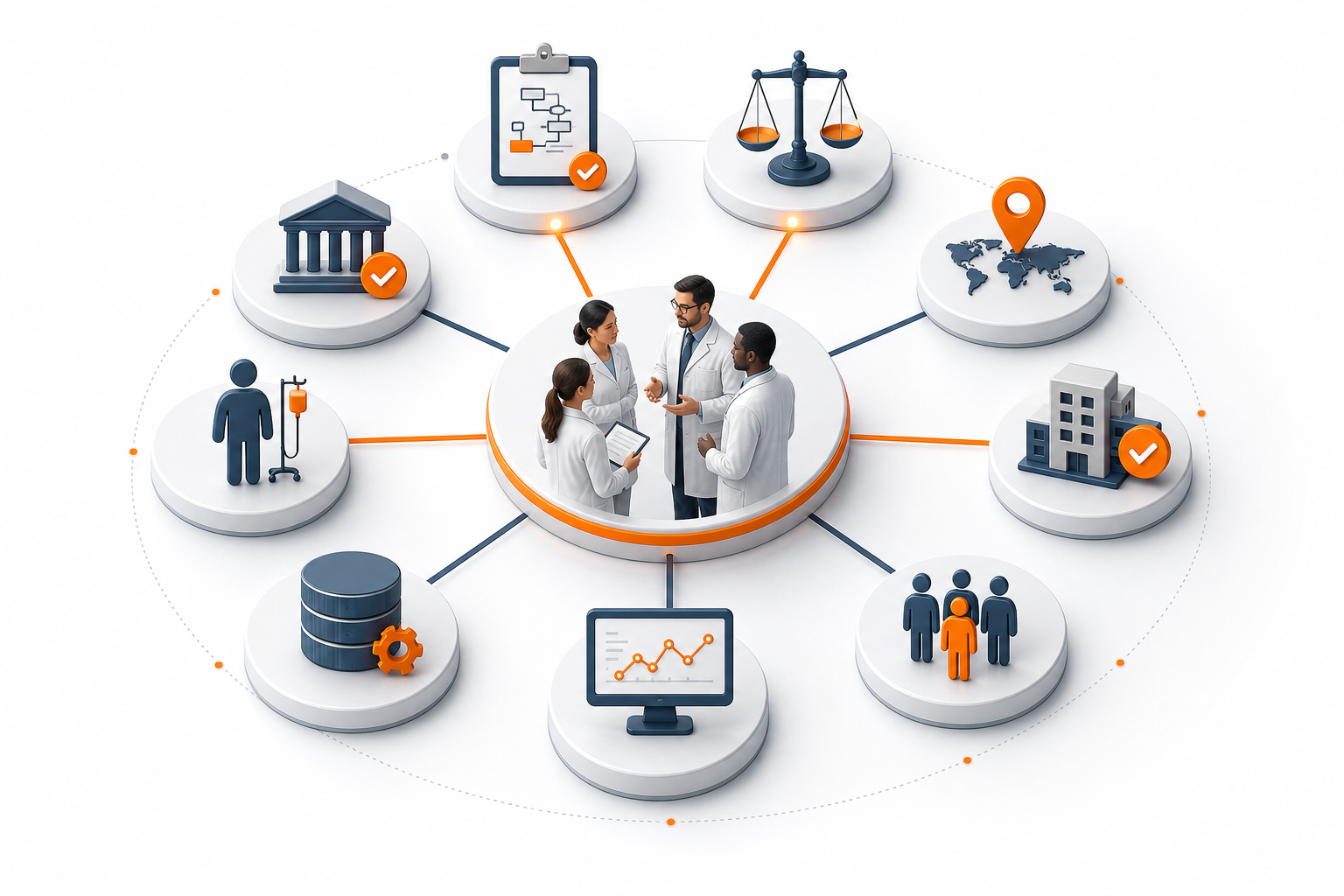
Most sponsors underestimate how many distinct workstreams run in parallel before, during, and after a FIH study. It's not simply "get IRB approval, enroll patients, collect data." There are nine discrete areas of execution, each with its own regulatory requirements, dependencies, and failure modes. Understanding what happens in each one helps you ask sharper questions of any CRO you evaluate — and helps you spot the gaps before they become delays.
This article walks through all nine workstreams in practical terms, with the regulatory grounding a sponsor-facing audience actually needs.
Why the Nine-Workstream Model Matters
FIH programs fail or stall for predictable reasons: a protocol that doesn't survive ethics review, a site that was never properly qualified, enrollment projections that were never stress-tested against the actual patient population, or a data package that arrives at FDA needing remediation before anyone can review it.
Each of those failure modes maps to a specific workstream. When accountability for any one of them is unclear — or split across multiple vendors — the risk compounds. A single team holding ownership across all nine workstreams is a structural advantage, not a marketing claim.
The nine workstreams described below reflect the architecture of the bioaccess® FIH-12 program, which carries a 12-month timeline guarantee from protocol to submission-ready evidence package.
Workstream 1: FDA Pre-Submission and Regulatory Pathway Alignment
Before a single patient is enrolled, you need clarity on which regulatory pathway applies to your device or molecule — and whether your FIH data strategy will satisfy FDA's evidentiary expectations.
For medical devices, that typically means a Pre-Submission (Pre-Sub) meeting with FDA to align on IDE requirements, study design, and the evidence package FDA will need before granting clearance or approval. For drug or combination products, IND pathway alignment serves the same function.
If your FIH study is conducted outside the US, this workstream also covers FDA 21 CFR 812.28 compliance — the framework governing how foreign clinical data from IDE studies is structured for US submission. Data collected under ISO 14155 protocol architecture and ICH-GCP standards satisfies this requirement when properly documented.
Getting this workstream right at the start prevents costly protocol amendments and data gaps down the line.
Workstream 2: Jurisdiction Selection and Regulatory Strategy
Where you run your FIH study determines how fast you can start it, what it costs per patient, and how cleanly the data bridges back to FDA.
Ethics and regulatory approvals in Panama (MINSA/CNBI), El Salvador (SRS/CNEIS), Chile (ISP/MINSAL), and the Dominican Republic are observed in 30 to 90 days. That compares to 6 to 12 months in the US or EU. For a startup operating on a 12-to-18-month runway between funding rounds, that difference is material.
Jurisdiction selection also affects site access, patient population characteristics, and per-patient cost structure. This workstream produces a documented country route recommendation — with a timeline range and evidence package estimate — tied to your specific device or molecule.
Workstream 3: Protocol Development
The protocol is the operating document for everything that follows. A weak protocol creates downstream problems at every stage: ethics rejection, site confusion, data inconsistencies, and FDA questions during review.
A strong FIH protocol defines the study design (typically a prospective, single-arm feasibility study for devices), primary and secondary endpoints, inclusion and exclusion criteria, safety monitoring rules, stopping criteria, and the statistical framework for the evidence package.
For medical devices, ISO 14155 governs protocol architecture. For drug or combination products, ICH E6(R2) GCP applies. In practice, both frameworks demand the same discipline: endpoints that are measurable, criteria that are defensible, and a safety monitoring plan that satisfies both the ethics committee and FDA.
Protocol development in this workstream also includes the informed consent document, adapted to the language and regulatory requirements of the operating jurisdiction.
Workstream 4: Ethics and Regulatory Submissions
Once the protocol is finalized, it goes to the relevant ethics committee and regulatory authority in the operating jurisdiction. This is where jurisdiction selection pays off most directly.
In Panama, the Comité Nacional de Bioética de la Investigación (CNBI) and MINSA review submissions concurrently. In Chile, ISP and MINSAL handle device and drug trials respectively. In El Salvador, the SRS and CNEIS process submissions in parallel. Each jurisdiction has a defined review window, and across the four primary operating jurisdictions, that window falls within 30 to 90 days.
This workstream covers preparation of the full submission dossier — protocol, investigator brochure or device description, informed consent forms, investigator CVs, and site documentation — formatted to each authority's requirements.
Workstream 5: Site Activation
Site activation is one of the most underestimated sources of delay in FIH programs. A site that looks qualified on paper may have no experience with your device category, an investigator overcommitted to other trials, or a pharmacy that can't handle your product's storage requirements.
This workstream covers site feasibility assessment, investigator qualification review, site initiation visits, and execution of clinical trial agreements and financial disclosure forms. For radiopharmaceutical programs involving Lu-177, Ac-225, or Ga-68, site activation also includes verification of radiopharmacy infrastructure and isotope handling protocols.
A pre-qualified site network eliminates most of the feasibility risk. With 50-plus pre-qualified sites across 19 Latin American and Caribbean markets, site selection becomes a matching exercise — not a cold-start recruitment effort.
Workstream 6: Patient Enrollment and Retention
Enrollment projections are where optimism most reliably collides with reality. Sites routinely overestimate their eligible patient population, and sponsors routinely underestimate the time from site activation to first patient in.
This workstream covers enrollment planning — site-level projections, screen failure rate assumptions, and enrollment rate modeling — along with patient identification and screening, informed consent execution, and retention strategies for the duration of follow-up.
In Latin American markets, patient populations for many device indications are larger, less fragmented across competing trials, and more accessible through established referral networks. That structural advantage translates directly into faster enrollment timelines.
Workstream 7: Clinical Operations and Safety Monitoring
Once patients are enrolled, clinical operations covers everything happening at the site level: procedure execution, adverse event capture, protocol deviation management, and ongoing safety monitoring.
Safety monitoring is particularly intensive in FIH studies. With no prior human safety data to anchor your stopping rules, the stakes of every adverse event are higher. This workstream includes the Data Safety Monitoring Board (DSMB) or equivalent safety review mechanism, real-time adverse event reporting to the ethics committee and regulatory authority, and site monitoring visits — on-site or remote — to verify protocol compliance.
ICH-GCP and ACRP-certified clinical operations staff are the standard here. Monitoring visit reports, deviation logs, and safety narratives generated in this workstream feed directly into the final evidence package.
Workstream 8: Data Management and Biostatistics
Data management converts raw clinical observations into a structured, auditable dataset. This workstream covers EDC system setup and validation, data entry and query resolution, database lock, and statistical analysis.
For FDA submissions, the data package must be structured in a format that supports review without remediation — clean audit trails, resolved queries, and a statistical analysis plan that was pre-specified in the protocol, not reverse-engineered after database lock.
Biostatistics in FIH studies is typically descriptive rather than inferential. The goal is to characterize safety and initial performance signals, not to power a hypothesis test. But the statistical analysis plan still needs to be prospectively defined and executed consistently.
Workstream 9: Regulatory Submission Package Preparation
The final workstream converts the completed study into a submission-ready evidence package for FDA. For device programs, that's the clinical section of a 510(k) or PMA submission, or the clinical data module of an IDE application for the next study phase. For drug programs, it's the clinical study report (CSR) and the relevant IND amendment.
This workstream covers the clinical study report, summary of safety and effectiveness data (SSED), tabulations, listings, and figures (TLFs), and the narrative sections that contextualize the data for FDA reviewers.
Data collected under ISO 14155 and structured per FDA 21 CFR 812.28 is accepted for US IDE and IND submissions. The submission-ready package produced here is the deliverable that closes the FIH milestone and opens the door to the next funding conversation.
How the Nine Workstreams Fit Together
The workstreams don't run strictly in sequence. Workstreams 1 and 2 — regulatory pathway alignment and jurisdiction selection — must complete before Workstream 3 (protocol development) can finalize. Workstreams 4 and 5 (ethics submissions and site activation) run in parallel. Workstreams 6, 7, and 8 (enrollment, clinical operations, and data management) overlap throughout the active study period. Workstream 9 begins before database lock, as report templates and statistical shells are built during the study.
Managing those dependencies without a single accountable team is where most programs lose time. When the protocol team, the regulatory team, the site team, and the data team operate in silos, handoffs become bottlenecks.
The bioaccess® FIH-12 program is structured around single-team ownership of all nine workstreams, with a 12-month timeline guarantee from protocol to submission-ready evidence package. If you're at the stage of mapping out your FIH program, the FIH Launch Planner on the bioaccess® website generates a preliminary country route, timeline range, and evidence package estimate based on six questions about your program.
FAQs
What is a first-in-human clinical trial?
A first-in-human clinical trial is the initial study in which a new medical device, drug, or combination product is tested in human subjects for the first time. For medical devices, it typically takes the form of an early feasibility study (EFS) designed to assess safety and initial performance signals before a larger pivotal trial.
How long does a first-in-human clinical trial take?
Timeline depends heavily on jurisdiction and program structure. In the US or EU, ethics and regulatory approvals alone can take 6 to 12 months. In Panama, El Salvador, Chile, and the Dominican Republic, those approvals are observed in 30 to 90 days. A structured FIH program covering all nine workstreams — from protocol to submission-ready evidence package — can be completed in 12 months in those jurisdictions.
Does FDA accept clinical data collected outside the United States?
Yes. Under FDA 21 CFR 812.28, foreign clinical data from IDE studies conducted outside the US is accepted for US submissions when the study is conducted under ISO 14155 protocol architecture and ICH-GCP standards, and when the data is properly documented and structured for FDA review.
What is the difference between an early feasibility study and a pivotal trial?
An early feasibility study or FIH study is designed to generate initial safety and performance data in a small patient cohort, typically 10 to 30 subjects. A pivotal trial is a larger, statistically powered study designed to support a marketing authorization — 510(k), PMA, or NDA/BLA. FIH data often feeds directly into the design of the pivotal trial and may be included in the marketing submission.
What does "submission-ready evidence package" mean?
A submission-ready evidence package is a complete, auditable clinical data package formatted for FDA review. It includes the clinical study report, statistical analysis outputs, safety narratives, and supporting documentation structured to satisfy the evidentiary requirements of a 510(k), PMA, IDE, or IND submission. It's the deliverable that closes the FIH milestone.
Why does single-team accountability across all nine workstreams matter?
When different vendors own different workstreams, handoffs create delays and accountability gaps. A protocol amendment requested by the ethics committee may not reach the data management team in time to update the EDC. A site activation delay may not be reflected in enrollment projections until the sponsor is already behind. Single-team ownership eliminates those gaps by keeping all nine workstreams under one accountable point of contact.
What is the per-patient cost for a first-in-human study in Latin America?
Per-patient costs in Panama range from $12,000 to $22,000 — materially below US and EU CRO pricing for comparable FIH programs. Total program cost depends on the number of subjects, the device or molecule category, the number of sites, and the scope of the evidence package required.
Plan Your FIH Program Around the Full Nine Workstreams
Most FIH delays aren't caused by science. They're caused by gaps in planning, unclear ownership, and jurisdictions that weren't selected with regulatory speed in mind.
Understanding what happens in each workstream gives you a framework for evaluating any CRO you consider — and for stress-testing your own timeline assumptions before you commit to a board milestone or investor deadline.
If you're mapping out your first-in-human program, bioaccess® covers all nine workstreams under a single team, with a 12-month timeline guarantee and operations across 19 Latin American and Caribbean markets.
WordPress Category: Navigating Regulatory Landscapes in Latin America
Leave a Reply