- What an Early Feasibility Study Is and Why It Matters
- Regulatory Requirements by Jurisdiction
- How Latin American EFS Data Gets Accepted by the FDA
- Site Qualification Criteria for an Early Feasibility Study
- Protocol Architecture for a Latin American EFS
- Timeline Structure for a Latin American EFS
- What the Evidence Package Needs to Contain
- Working with a CRO That Knows Both Sides
- FAQs
- Start with the Right Structure
Running an early feasibility study (EFS) outside the United States is not a workaround. For many MedTech and biopharma sponsors, it is the most direct path to a first-in-human dataset the FDA will actually accept. Latin America has become a serious destination for EFS execution because its regulatory timelines, site infrastructure, and per-patient economics align with what early-stage sponsors genuinely need.
This article covers what an EFS requires across Latin American jurisdictions, which regulatory bodies are involved, what site qualification looks like in practice, and how the data you collect gets structured for your U.S. regulatory pathway.
What an Early Feasibility Study Is and Why It Matters
An early feasibility study is a small, limited first-in-human (FIH) clinical investigation designed to evaluate initial device or therapy performance, safety signals, and proof-of-concept in a human population. It typically precedes a pivotal trial and generates the foundational clinical evidence that informs protocol refinement, device iteration, and regulatory submissions.
In the U.S., the FDA's EFS pathway under the IDE framework is well-defined but slow. Ethics and IDE approvals routinely take 6 to 12 months before a single patient is enrolled. For a startup with 18 months of runway and a Series A milestone tied to first human data, that timeline simply does not work.
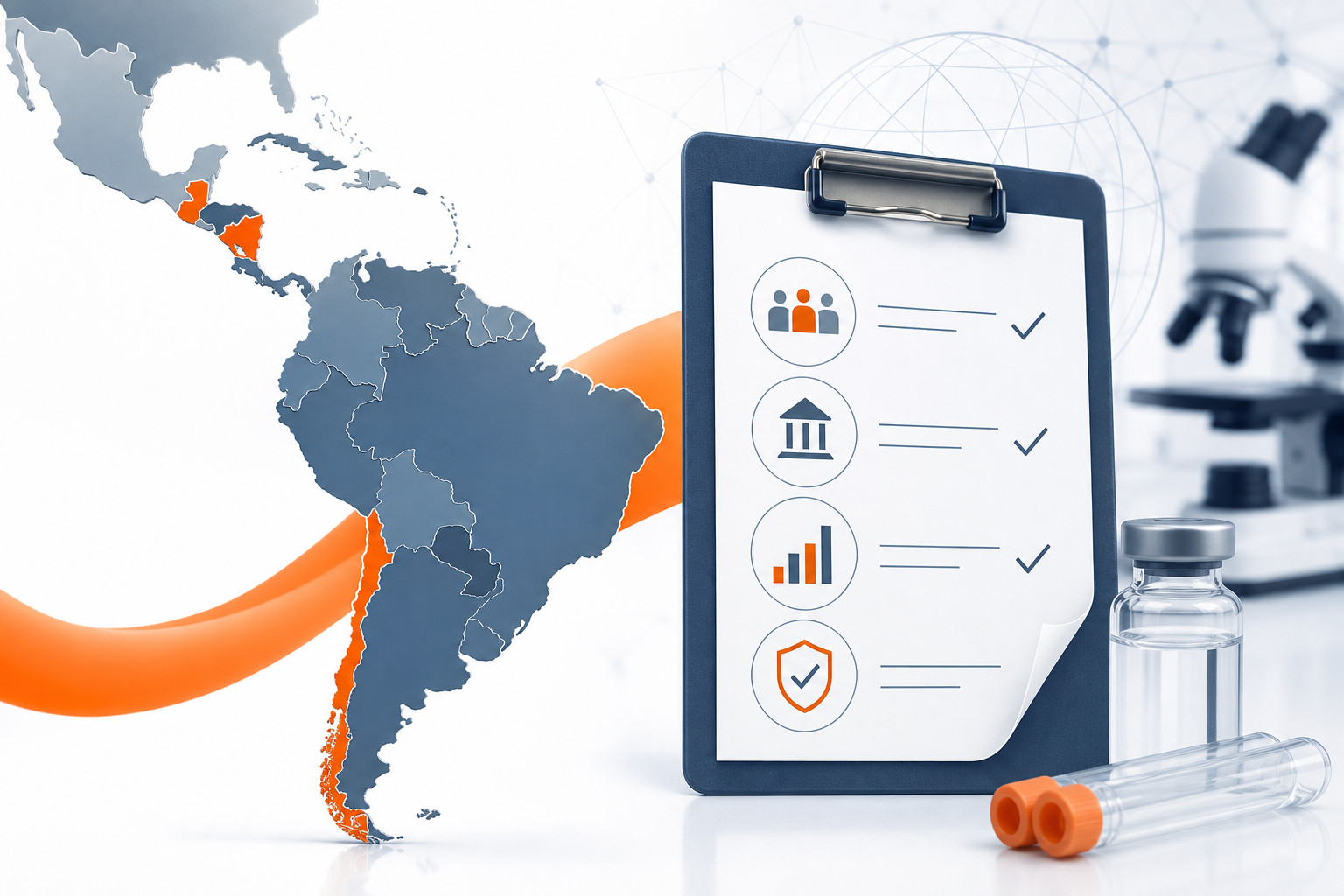
Latin American jurisdictions offer a structurally different environment. Ethics and regulatory approvals in Panama (MINSA/CNBI), El Salvador (SRS/CNEIS), Chile (ISP/MINSAL), and the Dominican Republic are observed in 30 to 90 days. That is not a promotional claim — it reflects documented operating experience running trials through those authorities. The health authorities retain full discretion over their review timelines; the 30-to-90-day range describes what sponsors actually encounter, not a contractual commitment from any regulatory body.
Regulatory Requirements by Jurisdiction
Panama (MINSA/CNBI)
Panama's Ministry of Health (MINSA) and the National Bioethics Committee (CNBI) jointly govern clinical research approvals. Panama is one of the most commonly selected EFS jurisdictions in Latin America, valued for its approval speed, English-language familiarity in the clinical community, and established infrastructure for international trials.
For a device EFS, the sponsor typically submits a clinical investigation protocol, investigator brochure or device description, informed consent forms, investigator CVs, site credentials, and evidence of GCP training. CNBI review focuses on ethical adequacy of the study design, subject protection, and risk-benefit framing. MINSA review addresses the regulatory classification of the device and the adequacy of the investigation plan.
Per-patient costs in Panama range from $12,000 to $22,000 — materially lower than comparable FIH trial costs in the U.S. or EU.
El Salvador (SRS/CNEIS)
El Salvador's Regulatory Health Authority (SRS) and the National Ethics Committee for Health Research (CNEIS) handle clinical investigation approvals. El Salvador is a viable option for sponsors seeking a second site or a parallel enrollment pathway alongside Panama. The review structure is similar: protocol submission, ethics committee review, and authority-level regulatory clearance before site initiation.
Chile (ISP/MINSAL)
Chile's Public Health Institute (ISP) and Ministry of Health (MINSAL) govern clinical research. Chile has a more developed clinical research infrastructure than many other markets in the region, with experienced principal investigators and academic medical centers that are well-acquainted with ISO 14155 protocol architecture. For sponsors pursuing CE mark pathways in parallel with FDA submissions, Chile's regulatory environment is particularly relevant.
Other Jurisdictions
The operating footprint for EFS execution spans 19 Latin American and Caribbean markets, including Colombia, the Dominican Republic, Peru, Argentina, Brazil, and Mexico. Each jurisdiction has its own ethics committee and regulatory authority structure. Country selection for a specific EFS depends on device classification, therapeutic area, site capability, patient population availability, and the sponsor's intended regulatory pathway.
How Latin American EFS Data Gets Accepted by the FDA
This is the question sponsors ask most often, and it has a clear regulatory answer. FDA 21 CFR 812.28 governs the acceptance of foreign clinical data in IDE submissions. Data collected outside the U.S. is acceptable when the investigation was conducted in accordance with Good Clinical Practice (GCP), the submission includes a detailed description of the foreign regulatory framework, and the sponsor demonstrates that the data is relevant to the U.S. population and intended use.
In practice, this means the protocol must be structured to ICH-GCP and ISO 14155 standards from the outset, the ethics and regulatory approval process must be fully documented, and the final clinical study report must be organized in a format that maps directly to the FDA's evidentiary expectations.
Sponsors who try to retrofit a Latin American dataset into an FDA submission after the fact typically run into problems. The data package needs to be built for FDA use before the first patient is enrolled — not after the study closes.
This is why pre-submission alignment with the FDA matters. A Pre-Sub meeting that confirms your EFS protocol, country selection, and evidence package structure are acceptable to the FDA before you start protects the value of everything you collect.
Site Qualification Criteria for an Early Feasibility Study
Not every clinical site in Latin America is appropriate for an EFS. The criteria that matter most are:
Principal Investigator experience. The PI must have documented experience with the device type or therapeutic area, GCP certification, and familiarity with ISO 14155 for device studies. For novel device categories, the PI's ability to recognize and manage unanticipated adverse events is a primary selection criterion.
Facility capability. The site must have the equipment, staffing, and emergency response infrastructure to support the specific procedure or intervention being studied. A cardiovascular device EFS has different facility requirements than one involving a diagnostic tool.
IRB/ethics committee relationship. Sites with established relationships with the relevant national ethics committee — CNBI, CNEIS, or equivalent — move through the approval process more predictably. A site submitting to CNBI for the first time will face a longer runway than one with an established submission history.
Regulatory compliance history. Sites should have a clean inspection record and documented SOPs for source data verification, adverse event reporting, and protocol deviation management. For FDA-bridgeable data, the site's compliance posture directly affects the data's credibility in a U.S. submission.
Patient population access. EFS enrollment is typically small — often 5 to 30 subjects — but the site must have realistic access to the target population. Enrollment delays in an EFS are expensive relative to the study size. Sites with pre-screened patient registries or active referral networks in the relevant indication are preferable.
A network of 50-plus pre-qualified sites across a 19-country footprint means site selection can be matched to therapeutic area, enrollment feasibility, and country-level regulatory considerations rather than defaulting to whatever site is geographically convenient.
Protocol Architecture for a Latin American EFS
The protocol for a Latin American EFS must satisfy two audiences simultaneously: the local ethics committee and regulatory authority, and the FDA reviewer who will eventually evaluate the data.
Key protocol elements that affect both:
- Primary and secondary endpoints must be defined with enough specificity to generate interpretable data, but the EFS is not a pivotal study. The FDA expects EFS data to be exploratory and hypothesis-generating, not statistically powered for regulatory approval.
- Subject selection criteria must be defensible to the local ethics committee and relevant to the U.S. intended use population. If the enrolled population differs meaningfully from the U.S. target population, the sponsor needs to address that in the FDA submission.
- Stopping rules and safety monitoring must be explicit. Ethics committees in Panama, El Salvador, and Chile expect clear criteria for study suspension and a defined safety monitoring process.
- Data collection instruments must be structured for electronic data capture (EDC) systems that produce audit-ready, FDA-compatible data exports. Paper-based data collection in a 2026 EFS creates unnecessary friction in the FDA submission process.
- Informed consent must be translated, culturally adapted, and approved by the local ethics committee. Submitting a U.S.-formatted consent form without adaptation is one of the most common sources of ethics committee delays.
Timeline Structure for a Latin American EFS
A realistic timeline from protocol finalization to last patient last visit looks like this:
- Protocol development and Pre-Sub alignment: 4 to 8 weeks
- Ethics and regulatory submission preparation: 2 to 4 weeks
- Ethics and regulatory approval (observed): 30 to 90 days
- Site initiation and investigator training: 2 to 4 weeks
- Patient enrollment: Varies by indication and enrollment rate; 8 to 16 weeks is a reasonable planning assumption for a 10-to-20-subject EFS
- Follow-up period: Defined by protocol; typically 30 days to 12 months depending on the device and endpoints
- Data lock, analysis, and clinical study report: 8 to 12 weeks post-last visit
When the regulatory approval phase runs 30 to 90 days rather than 6 to 12 months, the total elapsed time from protocol finalization to a submission-ready evidence package can fit within 12 months. That compression is what makes Latin America structurally different from U.S. or EU EFS execution for time-constrained sponsors.
What the Evidence Package Needs to Contain
When the EFS closes, the sponsor needs more than a clinical study report. An FDA submission-ready evidence package typically includes:
- Final clinical study report (CSR) structured per ICH E3 or equivalent
- Protocol and all approved amendments
- Ethics committee and regulatory authority approvals for each site and country
- Informed consent documentation
- Investigator CVs and GCP training records
- Site qualification documentation
- Source data verification (SDV) records
- Adverse event and serious adverse event (SAE) narratives
- Device accountability records
- Statistical analysis plan and output datasets
- Organized data room with document indexing aligned to the sponsor's FDA submission format
The data room structure matters more than sponsors often expect. An FDA reviewer evaluating an IDE submission that includes foreign clinical data needs to locate every supporting document quickly. Disorganized data rooms slow FDA review and generate unnecessary information requests.
Working with a CRO That Knows Both Sides
Running an EFS in Latin America requires a team that understands both the local regulatory environment and the FDA's expectations for foreign clinical data. Those are not the same skill set, and the gap between them is where sponsors lose time and data value.
bioaccess® operates across 19 Latin American and Caribbean markets with regulatory authority integrations active in Panama, El Salvador, and Chile, and a network of 50-plus pre-qualified sites. The FIH-12 program covers all nine workstreams from protocol development through final evidence package delivery, with the entire process structured for FDA acceptance under 21 CFR 812.28. Intake is limited to eight new programs per quarter — worth knowing if your timeline is anchored to an investor milestone or board deadline.
FAQs
What is an early feasibility study, and how does it differ from a pivotal trial?
An early feasibility study is a small first-in-human investigation designed to generate initial safety and performance data for a device or therapy. It is exploratory and typically enrolls 5 to 30 subjects. A pivotal trial is statistically powered to support a regulatory approval decision and enrolls a much larger population. EFS data informs protocol design and device refinement before a pivotal study begins.
Can data from a Latin American early feasibility study be used in an FDA IDE or 510(k) submission?
Yes. Under FDA 21 CFR 812.28, foreign clinical data is acceptable in IDE submissions when the investigation was conducted in accordance with GCP and the data is relevant to the U.S. population and intended use. The protocol must be structured for FDA acceptance from the start, and the evidence package must meet FDA evidentiary standards.
How long does regulatory approval take for an EFS in Panama or Chile?
Ethics and regulatory approvals in Panama (MINSA/CNBI), Chile (ISP/MINSAL), and El Salvador (SRS/CNEIS) are observed in 30 to 90 days. These are observed timelines based on operating experience in those jurisdictions, not contractual guarantees from the health authorities.
What site criteria matter most when selecting a Latin American site for an EFS?
The most important factors are principal investigator experience with the device type or therapeutic area, facility capability for the specific procedure, the site's established relationship with the national ethics committee, regulatory compliance history, and realistic access to the target patient population.
Does the EFS protocol need to be different for a Latin American submission versus a U.S. submission?
The core scientific and clinical content should be consistent. The protocol will need to be adapted for local ethics committee requirements, including translated informed consent forms and culturally appropriate subject communication. The protocol architecture should satisfy both ICH-GCP/ISO 14155 standards and the FDA's expectations for foreign clinical data from the outset.
What is the typical per-patient cost for an EFS in Panama?
Per-patient costs in Panama range from $12,000 to $22,000 — materially lower than comparable per-patient costs in U.S. or EU clinical trial settings.
How do I know which Latin American country is right for my EFS?
Country selection depends on your device classification, therapeutic area, target patient population, and intended U.S. regulatory pathway. Ethics committee review speed, site capability in your indication, and country-level regulatory classification of your device all factor into the decision. The FIH Launch Planner at bioaccessla.com can generate a preliminary country route and timeline estimate based on your specific program inputs.
Start with the Right Structure
An early feasibility study in Latin America is not a shortcut. It is a structured clinical investigation that has to satisfy both local regulatory authorities and the FDA's standards for foreign clinical data. The speed advantage is real — but only when the protocol, site selection, ethics submissions, and evidence package are built correctly from the beginning.
If you are 12 to 18 months from needing first human data and your timeline cannot absorb a 12-month U.S. regulatory approval process before enrollment starts, Latin America deserves serious evaluation. The regulatory infrastructure is there. The site network is there. The question is whether your evidence package will be built to cross the FDA finish line.
Learn more at bioaccessla.com.
Leave a Reply