- What Clinical Trial Data Management Actually Covers
- Why Data Management Decisions Affect Your Regulatory Outcome
- The Fragmentation Problem
- Questions to Ask a CRO Before You Commit
- How Data Management Fits Into the Broader FIH Workstream
- What "Submission-Ready" Actually Means
- The Regulatory Context for Foreign Clinical Data
- Practical Checklist Before Choosing a CRO for Data Management
- FAQs
WordPress Category: General
Data management is one of the least glamorous parts of running a first-in-human trial. It is also one of the most consequential. A clean, audit-ready dataset is what separates a submission-ready evidence package from a pile of files that need months of remediation before they can go anywhere near the FDA.
If you are a MedTech or biopharma founder evaluating CROs, how a prospective partner handles clinical trial data management will tell you a great deal about how the rest of the engagement will go.
This article covers what data management actually involves in an early-phase trial, the questions worth asking before you sign a contract, and the structural factors that shape data quality from day one.
What Clinical Trial Data Management Actually Covers
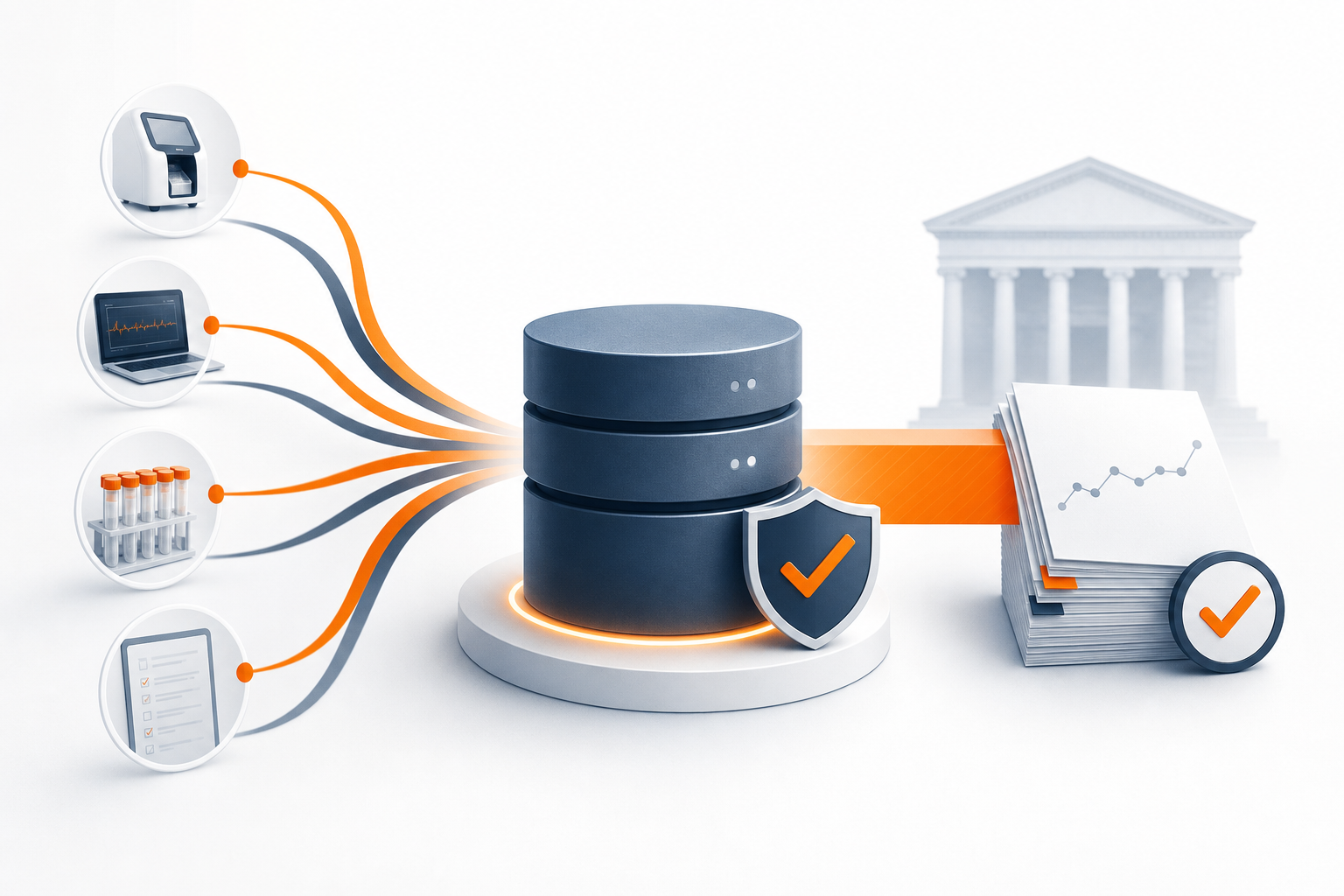
The term gets used loosely. In practice, clinical trial data management is the end-to-end process of collecting, cleaning, validating, and locking study data so it meets regulatory standards for submission.
For a first-in-human study, that process spans several distinct activities:
- Electronic Data Capture (EDC) setup and validation — building case report forms (CRFs) that map to your protocol endpoints and configuring the system to flag out-of-range values automatically
- Data entry and source data verification (SDV) — confirming that what was recorded at the site matches source documents
- Query management — identifying and resolving discrepancies between site-entered data and expected values
- Medical coding — applying standard dictionaries (MedDRA for adverse events, WHO Drug for concomitant medications) so your safety data is interpretable
- Database lock — the formal closure of the database after all queries are resolved, after which no changes can be made without documented justification
- Data transfer and archiving — packaging the final dataset in formats compatible with your regulatory submission
Each of these steps has its own timeline, personnel requirements, and documentation burden. When any one of them is handled by a separate vendor, coordination risk multiplies.
Why Data Management Decisions Affect Your Regulatory Outcome
The FDA does not just review your clinical findings. It reviews the integrity of the process that produced them. Under 21 CFR 812.28, foreign clinical data submitted in support of a US device application must meet the same quality standards as data collected domestically. That means your EDC configuration, audit trails, query logs, and database lock documentation all become part of the evidentiary record.
For a startup running a first-in-human study on a 12-to-18-month timeline, data management quality has a direct effect on whether your clinical study report is submission-ready or requires remediation. Remediation after database lock is expensive, time-consuming, and sometimes impossible without reopening the database — which itself requires a documented rationale.
Protocols built to ISO 14155 architecture include data management requirements as a defined component, not an afterthought. If your CRO cannot describe how their data management plan aligns with ISO 14155, that is a meaningful gap.
The Fragmentation Problem
Most early-phase sponsors underestimate how often data management gets split across vendors. A CRO may handle protocol development and site activation while a separate EDC vendor manages the database, a biostatistics firm owns the analysis plan, and a medical writing group produces the final report. Each handoff is a point of failure.
When the EDC vendor configures CRFs without input from the biostatistician, you get a dataset that technically captures the data but does not support the analysis you need. When the medical writing group receives the final dataset without context from the clinical team, the narrative in the study report may not align with the data tables. These are not hypothetical problems. They are common ones.
The practical question to ask any CRO: who owns data management within your organization, and at what point do external vendors enter the process?
Questions to Ask a CRO Before You Commit
Before issuing an RFP or signing a master service agreement, these questions will give you a clearer picture of how a CRO actually manages data:
1. What EDC platform do you use, and is it validated under 21 CFR Part 11?
21 CFR Part 11 governs electronic records and signatures in FDA-regulated trials. Any EDC system used in a study intended for FDA submission must meet these requirements. Ask for documentation.
2. Who writes the data management plan, and when?
The data management plan (DMP) should be finalized before the first patient is enrolled. If a CRO cannot walk you through their DMP process in detail, that is a flag.
3. How are queries generated and resolved?
Automated edit checks catch many discrepancies, but manual review by a clinical data manager is still necessary. Ask about turnaround time for query resolution and how unresolved queries get escalated.
4. What is your process for medical coding?
MedDRA and WHO Drug coding require trained personnel and version-controlled dictionaries. Ask which version they use and how coding decisions are documented.
5. How is the final dataset structured for regulatory submission?
If your intended pathway is a 510(k), De Novo, PMA, or IDE, your dataset needs to be organized to support that specific submission. A generic data export is not the same as a submission-ready data room.
6. Who has access to the database during the study, and how is access controlled?
Audit trail integrity depends on controlled access. Ask how the CRO manages user permissions and what happens when a site coordinator leaves mid-study.
7. What does database lock look like, and what is your timeline from last patient visit to locked database?
Some CROs take 90 days or more to lock a database after last patient visit. For a startup on a funding timeline, that gap matters more than most founders realize.
How Data Management Fits Into the Broader FIH Workstream
Data management does not exist in isolation. It is one workstream within a larger clinical operations structure, and its quality depends on decisions made well upstream — how the protocol was written, how sites were trained, how CRFs were designed, and how adverse events were captured in real time.
This is why the organizational structure of your CRO matters as much as their technical capabilities. When one accountable team manages protocol development, site activation, patient enrollment, and data management under a single engagement, the decisions that affect data quality are made with the downstream submission already in mind.
bioaccess® structures its FIH-12™ program around nine integrated workstreams, with data management as a defined component of the evidence package deliverable. The final output is a clinical study report and organized data room structured for the sponsor's next FDA regulatory step — not a raw dataset handed off to a third party.
What “Submission-Ready” Actually Means
Sponsors sometimes assume a locked database is the same as a submission-ready package. It is not.
A submission-ready evidence package includes the clinical study report, the statistical analysis, data tables and listings, the protocol and amendments, informed consent documentation, site qualification records, and an organized data room that an FDA reviewer or Pre-Sub meeting team can navigate without additional explanation.
Producing that package requires tight coordination between data management, biostatistics, medical writing, and regulatory strategy. When those functions are siloed, the package often requires significant assembly work after the study closes — adding weeks or months to the timeline.
For a startup 12 to 18 months from a funding milestone, that assembly time is not a minor inconvenience. It is a material risk to your Series B narrative.
The Regulatory Context for Foreign Clinical Data
Running a first-in-human study outside the US does not lower the bar on data management. Under 21 CFR 812.28, the FDA accepts foreign clinical data in support of device applications when it meets the same quality standards as domestic data — including audit trail integrity, source data verification documentation, and a data management plan that was in place before enrollment began.
This is not a formality. FDA reviewers do examine data management documentation during Pre-Sub meetings and IDE reviews. A data room missing query logs, lacking a signed DMP, or showing gaps in audit trail continuity will generate questions that slow your submission.
Practical Checklist Before Choosing a CRO for Data Management
Use this as a starting point when evaluating vendors:
- EDC system validated under 21 CFR Part 11
- Data management plan finalized before first patient enrolled
- Protocols built to ISO 14155 (for medical devices)
- MedDRA and WHO Drug coding with documented version control
- Audit trail intact and exportable
- Clear timeline from last patient visit to database lock
- Final dataset structured for your specific FDA pathway
- One team accountable for data management through submission, not a handoff to a third party
FAQs
What is clinical trial data management in the context of a first-in-human study?
It is the end-to-end process of collecting, cleaning, validating, and locking study data to meet regulatory standards. For a FIH study, that covers EDC setup, source data verification, query management, medical coding, database lock, and final dataset packaging for FDA submission.
Does the FDA review data management documentation for foreign clinical studies?
Yes. Under 21 CFR 812.28, foreign clinical data submitted in support of a US device application must meet the same quality standards as domestic data — including audit trail documentation, the data management plan, and query resolution records.
What is a data management plan, and when should it be written?
A data management plan (DMP) describes how data will be collected, validated, stored, and transferred throughout the study. It should be finalized before the first patient is enrolled. A DMP written after enrollment begins is a regulatory gap.
What is the difference between a locked database and a submission-ready evidence package?
A locked database is the final, closed dataset. A submission-ready evidence package includes the locked database plus the clinical study report, statistical analysis, data tables and listings, protocol documentation, and an organized data room structured for your specific FDA pathway.
How does fragmented vendor management affect data quality?
When EDC configuration, biostatistics, and medical writing are handled by separate vendors without a single accountable team, upstream decisions made by one vendor routinely create problems for the next. CRF design that does not account for the analysis plan is a common example. One integrated team reduces these handoff risks significantly.
What EDC standards apply to trials intended for FDA submission?
Any EDC system used in a study intended for FDA submission must comply with 21 CFR Part 11, which governs electronic records and electronic signatures. The system must maintain a complete audit trail, control user access, and support data export in formats compatible with regulatory review.
How long does it typically take to lock a database after last patient visit?
It varies by CRO and study complexity. Some organizations lock within 30 to 45 days; others take 90 days or more. For a startup on a funding timeline, the gap between last patient visit and a locked, submission-ready dataset is a material planning variable — one worth clarifying before you sign.
Data management is not where most founders spend their due diligence time when evaluating a CRO. It should be. The quality of your final evidence package is determined by decisions made at the protocol stage, executed through enrollment, and finalized at database lock. A CRO that treats data management as a downstream function rather than an integrated workstream will cost you time at the moment you can least afford it.
If you are planning a first-in-human study and want to understand how data management fits into a structured, submission-ready program, bioaccessla.com is a useful starting point.
Leave a Reply